Pages

Tuesday, July 21, 2015

Part 5: the best part of a dream journey

Mark Twain said, "Travel is fatal to prejudice, bigotry, and narrow-mindededness, and many of our people need it sorely on these accounts. Broad, whole, charitable views of men and things cannot be acquired by vegetating in one's little corner of the earth all one's lifetime."

Traveling is important to me, and it is life-changing and life-expanding. Besides my frequent warm weather jaunts to East Tennessee or Western North Carolina or Northern Georgia to kayak with friends, I like to have a "big" trip in the saving's and planning stage.

Right now I'm saving, but I haven't quite decided where I'll go next. I'm considering the following places in no particular order: Charleston, SC; Highway 1 in Northern California; Mammoth Cave, KY; Rocky Mountain National Park, CO; Outter Banks, NC, Glacier National Park, MT, and Greece and Ireland. Just day-dreaming and listening to intuition for now.

The Pacific North West (Seattle and Victoria, British Columbia), the Grand Canyon, Alaska, Yosemite, and New England (Vermont and Acadia, Maine, especially) have been some of my favorite places that I've visited, And now I can add the Grand Tetons to that list!

As I exited Yellowstone and traveled along US 26/89/191 on the sixth day of my 12-day journey, I wasn't quite prepared for what was to greet me. I turned a curve in the road, and suddenly, there they were--bigger than life--the Grand Tetons--one of the prettiest parts of the Rocky Mountains. My mouth literally dropped open. There they stood in their granite majesty with their sharp, craggy, icy, rocky beauty. There they stood against the bluest skies and reflected in the waters of Jackson Lake.


In contrast to their largeness bloomed the sweetest, little yellow spring flowers with brown centers.


Oh my, the Grand Tetons are indeed the loveliest mountain range I have ever seen! I will have to paint them one day soon.


Like any other place, of course, I'm sure you know that mere pictures don't do those mountains justice because pictures are simply one dimensional and visual. If one is not there, s/he misses out on the sounds, the fragrances, the tastes, and feel of the place. But the pictures take me back momentarily to my experience of the place.

These spring beauties were captured a few days later at Jenny Lake, along with these lovely aspen trees.


This is the picture that I will paint one day, but I will make the sky blue with those white clouds and the water of Jackson Lake will sparkle from the sun's rays! The Tetons are among the youngest mountains on the continent. Together the mountain range and valley (in which sits the town of Jackson) frame a majestic landscape of eight large lakes, many glaciers, numerous snowfields, and extensive pine, fir, and spruce forests.

After many more stops along the way that afternoon, I arrived in the famous ski town of Jackson or Jackson Hole, Wyoming. Jackson Hole sits in a high mountain valley; that's why it's usually called Jackson Hole. The valley is encompassed by the ranges of the Grand Tetons, bordered by the Teton Range on the west and the Gros Ventre Range on the east. Bisected by the Snake River, the valley is 80 miles long and 15 miles wide. It is a recreational utopia.


The town of Jackson has a marvelous old town square, adorned in each corner with four elk horn arches. It is dotted with a mix of historical buildings, upscale eateries, shops, and saloons. It is an art collector's paradise. The side walks appear to be made of old barn boards.

I spent the next four days in Jackson Hole--sight-seeing, hiking, shopping, rafting, and learning some of its history. After moutain men explored the area and trapped animals, the Homestead Act drew pioneers willing to take a chance on improving a free plot of land by the 1890s. The harsh climate sent many packing, but those who stayed and toughed it out used the abandoned parcels of land to their advantage and developed large ranches.

Several days later as I was buying boots for my granddaughters Tessa and Livvy, I actually met some of those ranchers, coming into town on a Saturday night!


Besides getting back to the Grand Tetons National Park every day that I could, I was looking forward to my raft trip on the celebrated Snake River.

Tuesday, July 7, 2015

The new pixar movie "Inside Out"

The new pixar movie Inside Out intrigued me. Like the main human character Riley, when I was young, I had been moved from a place that I loved to a new, unfamiliar place, and like her, I felt overwhelmed by all of my feelings. But unlike her, this experience happened to me time and again.

I do not think that Inside Out is a movie meant for children younger than, say seven. And even then, for them, discussing the movie with a grown up may be helpful.


On the other hand, I guess the movie could be watched on a purely superficial level. After all my son-in-law Nekos took the granddaughters, ages 5 and 2, to see the movie recently, and they seemed to enjoy it. But did they really have any idea what was going on? I'll have to ask them.

Like the novel Pilgrim's Progress or the drama Everyman, the movie Inside Out is an allegory--where five characters in the film represent abstract ideas. In this case, five of the main characters each personify an emotion. There are also three other characters in the movie who are human beings: 11-year-old Riley and her parents.


The two main characters in the movie are Happiness (Joy) and Sadness. Besides the humans, the other characters are Anger, Fear, and Disgust. These five emotions are supposedly the basic human emotions that we feel and that control the way we act or sometimes "act out." That's one of the aspects of the movie that intrigued me: these basic human emotions.

A short bit of research on basic human emotions revealed that some scientists believe that we have four human emotions: happiness, sadness, fear, and anger. Other believe that we have six basic emotions, adding disgust and surprise to the list. The main writer of Inside Out chose to go with the belief in six emotions, but he also chose to leave out surprise. Other scientists come up with seven emotions, and add contempt (hate) to the list. Still others add trust and anticipation to the list of basic human emotions, so that would make nine. Plus add in all of the "complex" emotions, and we are just one emotional heap!

Interesting to note that five of these nine emotions are negative ones. Or as in the movie four out of five of the emotions are negative. (Wow. That's curious. I'll have to think about that more later.) In the movie, it was Happiness that tried to dominate how the 11-year-old Riley viewed the world and felt about the recent move. Her parents had just moved her from Minnesota to San Francisco.

My own parents moved us no less than a dozen times before I reached the age of 17. I was born in Charleston, SC, then moved on to Camden, SC, then on to Chattanooga, TN, where I attended kindergarten, then on to Richmond, VA, then to Madison, TN, where I had some pretty idyllic childhood years, then to Old Hickory, TN. From there, we moved on to Louisville, KY, then there was a very short move to Orange, TX, then back to Madsion, TN, where I spend my best high school years, Then to Wilmington, NC, and then to Grifton, NC, where I graduated from high school. Then on we moved to Seaford, DE. From there I went to college in Murfreesboro, TN.

Now to you, I know those sound only like a listing of cities that my family lived in, but for me, each of those cities has memories--memories--as the movie made clear--that became part of my personality and part of my long term memory bank. Each of those moves informed who I became. I've written a blog post about most of those places. (Sadly, I didn't take the time to write about most of those place until I retired in my 60s. Had I been able to write about those places sooner, perhaps I could have had more peace in my life.)


Back to Inside Out, the movie makes a big deal about Riley having to move to San Francisco when she was 11 years old. It nearly tears her apart, and I could really relate to what she was going through. Her strong "islands" or staples of emotions that informed her personality were family, friendship, ice hockey (her main interest), honesty, and goofball island. As each island crumbled because of the damage caused by the move, Riley began to lose herself.


Joy kept trying to keep or put her back together, but she was not giving Sadness her fair access to Riley's psyche. Riley's mother kept telling her that they needed her to be her usual happy-go-lucky self to counteract all the things that kept going wrong with the move. It was all so familiar to me, and it all made so much sense.

My parents too would depend on me to stay happy during our many moves--but I, of course, felt anything but happy. I felt sad for loss of friendships, and angry for loss of interests (in one high school, the next year, my senior year, I was looking forward to being the literary editor of the school paper, but then we moved). I felt fearful going into new classrooms and seeing that sea of new faces looking up at me. Within my family, we did not discuss these feelings or thoughts. With each move so many questions buzzed through my young mind: would I be able to keep up with the new school work? Had I missed something important that I needed to know? Time and again--at least a dozen times--I lost myself.


But in all those soul-stealing moves and in my parents' constant fighting, I did not allow myself to feel sad. Once I left home for college, I had completely lost myself. College, for me, was a terrible experience, so I ended up marrying Tommy Cooper to escape it and to escape my family, and the rest is history (I've written my memoirs in my blog, which I have linked to several times above).


In the movie, once Riley allowed herself to feel her sadness (and once Joy allowed Sadness to take center stage), she and her parents talked about her and their feelings and comforted her, and Riley is on the way to adjusting herself to the move, to rebuilding her islands, and to finding herself again.


My family of origin lacked two important things that Rily's family had: strong family support and goofiness. For some reason, my family was not demostrative of nor verbal about their love for each other or for us daughters, and my family was always sooo serious. There was never any joking around or family fun. (When families constantly move around, they need to be strong families with strong senses of themselves to survive move after move.) Since my family environment had not been conducive to expressing feelings, as the song states, I began to look for love in all the wrong places.

Once I became a teacher, teaching was my island that I practically based my whole personality on! Then as my marriages didn't work out, friendship became an important island. Finally in my late 30s/early 40s, white water kayaking became a major island for me. In my retirement once teaching island crumbled, I had a hard time adjusting. I had lost myself again! Then art/writing island was born. And once my daughter married and my granddaughters were born, family island became significant. It's fun and interesting to take notice of the islands that inform our sense of self and that create our personalities.  

The lesson that the movie Inside Out teaches us so well is that if one is not allowed to feel sadness--to acknowledge so-called "negative" emotions--then her psyche cannot heal and the opposite emotion (happiness in this case) cannot re-surface. It's all so clear to me now. So I ask the Universe, can I go back and relive my teens and college years and twenties, knowing what I know now? Probably not.

An A+ movie. Go see it and have fun! I plan to take Tessa (my five-year-old granddaughter) to see it again! It helped me to understand myself better; perhaps it will help her too.    

Thursday, June 25, 2015

Part 4 of a dream journey--days 2-4 in Yellowstone

On day two, Mary from the hotel advised me to go to the Grand Canyon of Yellowstone, and it was my favorite place that I visited in the park.

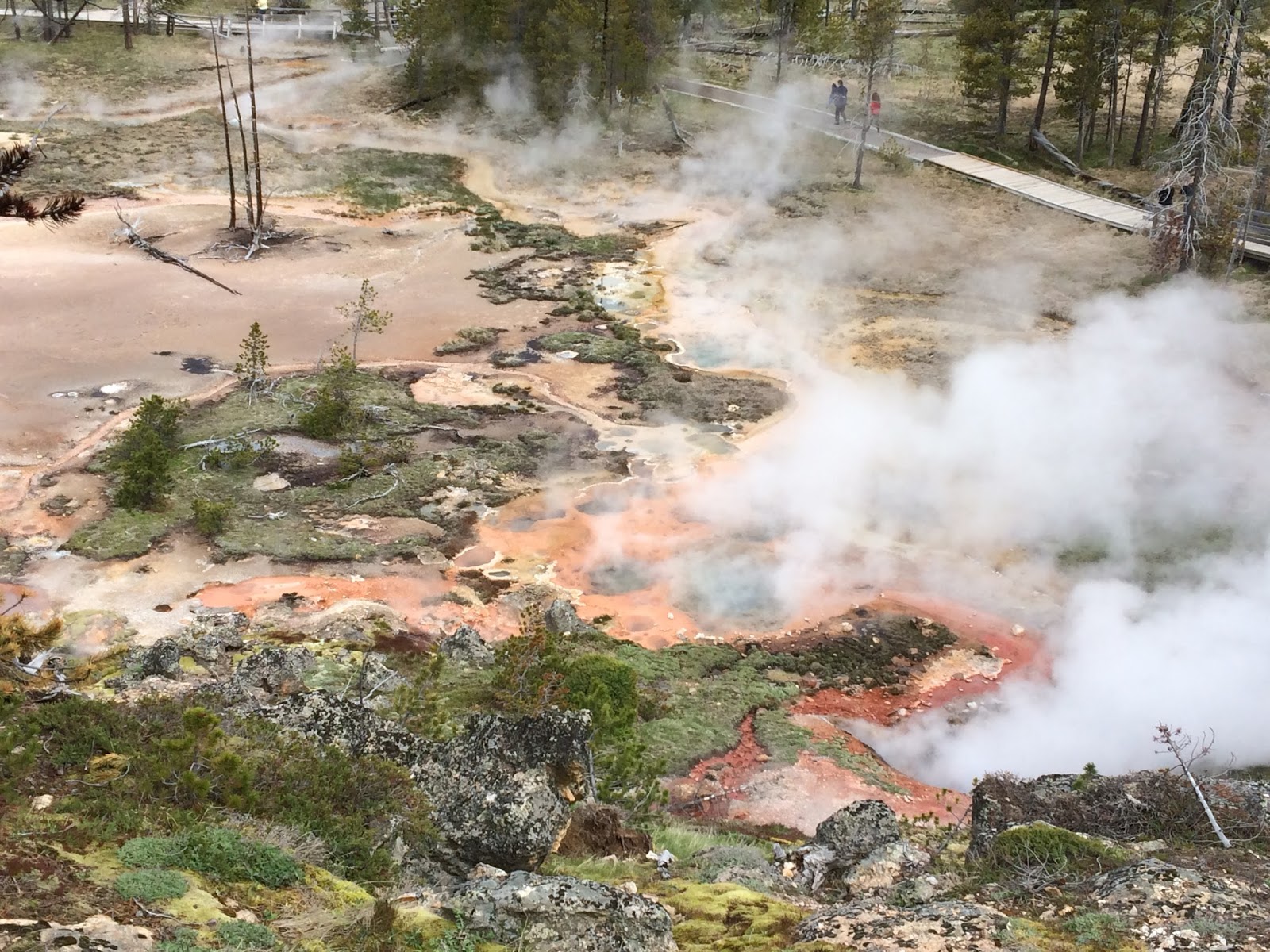
On the way to the canyon, I stopped to hike at the Paint Pots--and to watch those bubbling hot springs sprew their bright colors.


But it was the canyon that really mystified me! I could see immediately how Yellowstone Park got its name, and the waterfalls--both the upper and lower falls--were magnificent. And it was there that I first saw the Yellowstone River, which creates the waterfall below.


Stopping at a 1950's style cafe near the Canyon Lodge (which was not yet open), once again I had worked up a healthy appetite and appreciated a traditional lunch of delicious cheeseburger and fries. Thus ended another good day at YNP.

The next day back in West Montana, I decided to take a break from driving into the park. Instead I sayed in town and went to a bear (grizzly) and wolf sanctuary there in town. It was amazing to see those creatures so close up. They are truly beautiful wild animals.


Also I toured the historic Union Pacific train station, where in 1907 and thereafter, tourists used to come in on the train and then take stagecoaches through the park to the hotels. Until then visitation to the part was minimal because of its remote location, difficult access, and primitive accommodations. I took a step back in time as I toured the museum and the famous Union Pacific dining hall.


In my stay at West Yellowstone, Montana, I met so many people from all over the US and from other countries, such as the Netherlands and Australia. There were a lot of Asian tourists. One morning at breakfast when I asked an Asian woman where she was from, she answered, "LA! That's in California." West Yellowstone is a small town, but because of its gateway into Yellowstone, it's very cosmopolitan.

My last day in Yellowstone Park, once again I entered through the West Gate, but this time I drove 100 miles through the park to the South Gate, stopping at Mud Pots to hike to the mysterious Dragon's Mouth and other bubbling geothermal mud hot springs, where bufallo like to hang out to get warm in the winter. You'll see one fellow napping near a hot springs in the third picture below!


The number of geothermal features in Yellowstone--from geysers to hot springs to mud pots--is estimated at 10,000. YNP sits in a huge volcanic basin (caldera), which was the site of several massive volcanic eruptions, the last of which occurred about 600,000 years ago. These springs and geysers are caused by the build up of hot water and steam trapped below the surface.

Having seen enough geothermal features for this trip into Yellowstone, I was heading out, but it seemed that the antelope and bufallo did not want me to leave.


But by then, I was on my merry way to the Grand Tetons and famous Jackson Hole, Wyoming, to find out what made the Tetons grand and Jackson Hole famous, and nothing could stop me now--not even a few dozen bufallo!

Wednesday, June 17, 2015

Part 3 of a dream journey--Yellowstone!

Arriving in West Yellowstone, Montana, I settled into my hotel and made my nest for the next five nights. So this was Montana! Little did I know that this small town was the only part of Montana that I would visit. As in Boise, the town was surrounded by mountains, but these were higher and snow covered. These were the Rockies!


Though it was May 16, snow still lay on the ground in places from the unseasonable snowfall the week before my trip. I had packed two wool sweaters, two fleese vests, a light barn coat, wool socks, and my hiking boots. These proved to be plenty of clothes to keep me plenty warm for the next eleven days. Except for one day of rain, I found the weather to be cool, sunny, and perfect for my whole trip. There was no more snow!

Except to know that it was named the first national park in 1872, I had not done much research on Yellowstone because I wanted to wait until I got there. So the next morning, I met Mary, who worked there in the hotel, and asked her where I should go for my first foray into the park. She suggested that I may want to go about thirty miles into the park to Old Faithful--which had the most famous geyser as well as a famous old hotel. Though I knew that I probably couldn't afford to stay in them, old hotels were on my bucket lists of places that I wanted to visit and perhaps have a meal there.

The picture above is from my first entering Yellowstone National Park (YNP). Immediately in the park, I passed into the great state of Wyoming! The park was magical. Lots of moutains and swift rivers (This one is the Madison River.) and wild life--especially buffalo. Lots of close encounters with buffalo and their newly born calves. Also lots water falls (over 200 in the park) and lots of geothermal hot springs of many different colors from green to soothing turquoise to yellows and bright oranges. As I drove slowly (speed limit 45 mph) through the park, I might see steam rising from an area and came to realize that these were hiking areas (usually on raised wooden paths) to see hot springs.


Once I reached Old Faithful Inn, I had taken several hikes and built up a healthy appetite for lunch in the restaurant at the inn. I even got to enjoy huckleberry bread pudding--a real treat! After lunch, I was just in time to watch the Old Faithful Geyser, which erupts about every 90 minutes like clockwork! It was discovered in 1870, usually erupts for 90 seconds to five minutes, and rises from 100 to 200 feet.


After Old Faithful erupted, I scouted and hiked several acres in front of the inn and found many geothermal hot springs and one stream that allowed me to begin to see how Yellowstone got its name.


I said my farewells to Old Faithful Inn and geyser and headed back through the park, stopping often to hike and view other hot springs and Firehole River, which is a favorite river for fly fishing but in some places it is definitely a white water raging river on the edge of the park, created by the volcanic eruptions that created the whole park and that still apparently bubble below its surfice. (More on that later.) Firehole River contains three of the park's major waterfalls.


Thus ended my first day in Yellowstone.Who would have thought that going about 60 miles would have taken me all day? But besides the slow speed limit, there was just so much to see! And tomorrow I would view the famous Grand Canyon of Yellowstone Park National Park! 

Tuesday, June 9, 2015

A dream journey--part 2

As is obvious from my last post, it was those Grand Tetons that most impressed me on my trip out to the grand North West! (And more about the Tetons on another post.) Actually, all of my trip was filled with mountains, and I love mountains!

As you may recall, I flew in to Boise, Idaho, which was a way cool city to be in on the first night of the trip, and it was actually my first time in the state of Idaho. The city appears to be surrounded by lovely mountains--those kind of mountains that I had seen out in New Mexico and Arizona--the ones that are beautiful and all shades of brown.


The next morning I travelled east in Idaho toward Yellowstone in my small rented Toyota Yaris. Once I hit Highway 20, I was startled and swerved to avoid what appeared to be something coming my way from the prairie on the right. It was moving into the road and looked as if it could cause me to wreck, but I later discovered that it was only a double tumbleweed that had hooked itself together. None of the other cars on the road seemed to be paying any attention to them, so I quickly figured out that the tumble weeds may strike your car, but they were harmless; in fact, they could not even be felt. But oh my, they could be rather large and scarey at first--even bigger than giant beach balls!


As I continued to travel through Idaho, the brown mountains and hills gave way to green. Then on these mountains, there began to be pockets of evergreen trees. When the brown turned to green, I was in the Idaho's famous Sawtooth Mountains range.  After that, snow capped mountains begn to appear.


As I got closer and closer to the snow-covered mountains, lakes began to appear. Then all of a sudden, something changed!


Besides the lovely mountains and occasional lake, the most spetacular geographic display that I encountered that day was toward the end of my drive when I arrived in northwest Idaho at Craters of the Moon. For miles and miles, you drive through these amazing black lava fields and craters. You intuitively know that there must have been vocanos here at some time in the past. My research tells me that these other-worldly features are the result of basaltic volcanic activity between 15,000 and 2,100 years ago. Like so many places, no picture does them justice; you have to see them in person!


I stopped near and devoured my picnic lunch (chicken left over from dinner the night before) and stared into those dark earth crater and scruptures.


Little did I know that these craters were only a taste of what I was in for at Yellowstone National Park! If you tune in for the next installment in this blog, you may find out more than you ever wanted to know about that park. But really whether you have already been to Yellowstone (YNP) or are planning on going, I believe that you will appreciate what I have to share about it.