Pages

Tuesday, November 1, 2016

Southern Utah, Wow!

I had never even thought of putting the state of Utah on my bucket list until certain "signs" kept pointing me in that direction. Wow, am I now pleased that I listened to those "signs."  This is an account of my 10-day trip to Southern Utah in October, 2016--how exciting that I get to relive it as I write about it!

Flew into Salt Lake City (SLC) in Northern Utah on a Monday afternoon, October 10, drove the 4 or 5 hours to Moab in Southern Utah the next morning.

I had been to SLC before when I flew out of it after my Yellowstone and Grand Tetons trip in the spring of 2015. http://lauramallernee.blogspot.com/2015/06/a-dream-journey.html SLC is a lovely city surrounded by the Rocky Mountains, and that 75-mile-long Great Salt Lake, its 17 named islands, and its Salt Flats are definitely one of Utah's natural wonders. But I was heading out to visit some of her other natural wonders--5 national parks in Southern Utah!

On the drive to Moab, besides the landscape, which was tinged with the yellows of autumn and the bluest skies, the most interesting thing that I observed was a rancher on his horse with his Australian sherpherd in front of the horse and numerous sheep grazing on the mountainous slope behind them.


A rest stop along the way from SLC to Moab. I couldn't stop to get a picture of the sheep farmer/rancher; that picture is only in my mind's eye.

Moah is a quaint little town on the south side of Arches National Park. On Wednesday morning I made my first foray into ArchesNational Park. As soon as you pull into the park, in addition to the sculptured rock scenery--those red rocked pinnacles, balanced rocks, and towering spires--there are the dramatic La Sal Mountains in the near distance!


The park itself is filled with over 2,000 arches, ranging in size from a three-foot opening to a 306 foot opening at the base of Landscape Arch, and in contrast to all the red rock, there are the blue skies and some autumnal yellow flowers, and oh my, those luscious cottonwoods! 

I headed toward the arches named North Window and South Window and viewed them from a distance. Then took a short hike to Double Arches.


You do see the people standing there, right?!
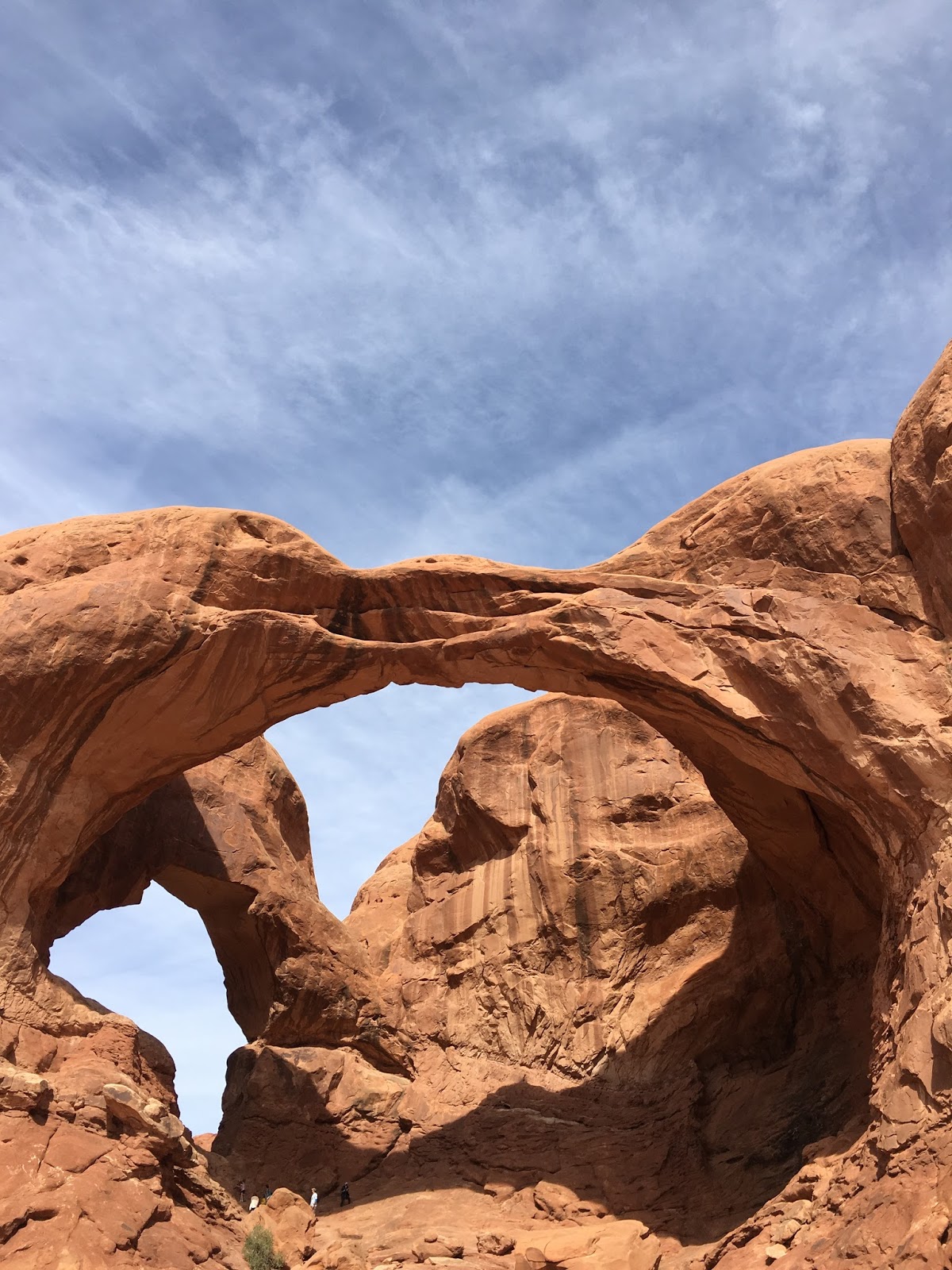


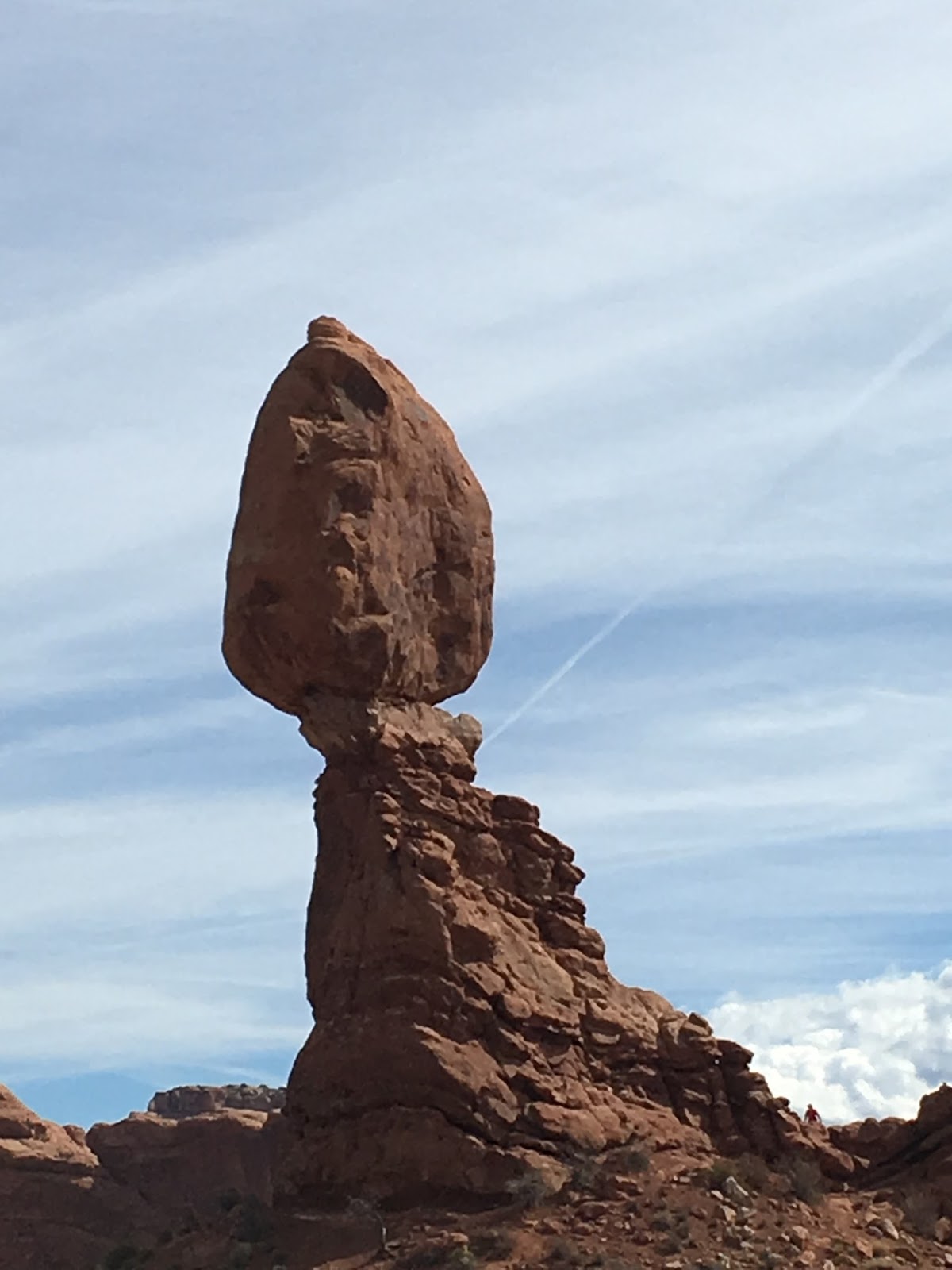
Once you are out of your car, the park itself has an intense aura of time, silence and vast scale. Those astonishing balanced rocks are perched atop seemingly inadequate bases. Most of the animals--mule deer, kit foxes, jack-rabbits, cottontails, kangaroo rats and other rodens, and small reptile--are noctunal.


Amid the salmon-colored Entrada Sandstone rock and buff-colored Navajo Sandstone, there are explosions of color. Pinyon and juniper trees add a splash of green contrast to the red sandsone terrain. Wild flowers bloom profusely from April to July. And in this fall season, autumn flowers bloom and cottonwood trees turn the loveliest of soft yellows.    


One of my favorite sculptures was entitled "the three gossips." One of my friends quickly renamed it "the three wise women"; I like that better! 


On my second day in Moab, I took a break from driving and hiking and rafted the Colorado River, which runs south of the park on its border. There were still many red-rocked formations to view from the river, and it was one of those perfect fall days for a gentle class 3 river trip.

My third day in Moab took me back into the Arches NP that morning to see the famous Delicate Arch. Native Americans used this area for thousands of years. The Archaic peoples, and later ancestral Puebloan, Fremont, and Utes, searched the arid desert for food animals, wild food plants, and stone for tools and weapons.


If you look closely, you can see tiny specks of people hiking their way nearer to Delicate Arch. I stopped at the the trail head near Wolfe ranch, where people were beginning the three-mile hike to Delicate Arch. Most of them had come prepared for such a hike over rough terrain, with plenty of sun lotion, hats, lots of water, walking sticks, and trekking poles. I chose a shorter hike at another trail head--though I could not get as close as they, it was good enough for me!

By the way, Wolfe "ranch" was settled by two of the earlier non-native explorers. John Wesley Wolfe and his son Fred settled there in the late 1800s and operated a primitive ranch for over 20 years. Ranchers in the area found abundant grasses for cattle and sheep. All that remains of the Wolfe ranch is a weathered log cabin, root cellar, and corral. 

After I hiked to Delicate Arch, I decided to skip Canyonlands NP, which was an hour's drive in the opposite direction from where I needed to go, and drive to Capitol Reef  National Park. I'm glad I skipped CNP because I was fatigued, Even with an interstate speed limit of 80, Capitol Reef was a little further than I expected--a good 3 hours. The scenery from the interstate was not impressive, and it wasn't until I got off the interstate and onto the windy roads that I found Utah's beauty again--especially in Capitol Reef National Park. 

to be continued   

Wednesday, August 31, 2016

The story of Rose


Rose has been my massage therapist for several years now. Usually I don't talk much during my massage—just lie there and enjoy. But yesterday, I was in the mood to ask her questions about her and her life. I knew so little about her.

Now in her mid-fifties, she has been in this country about sixteen years. Originally she and her family are from Croatia, a country east of Italy and north of Greece.

Rose has a rather strong accent and sometimes still struggles with her English. She will pause in talking to me and say almost to herself, “How to say . . .” She told me that when she first came to the United States, she talked a lot with her hands to make herself understood. Now as a massage therapist, she talks with her strong, caring hands to make others feel better.


She was already married with two children when her homeland of Croatia began a bitter, harsh civil war. Money and food became scarce, and Rose and her family had begun to sell the things in their house to buy food, but the things of value were getting to be fewer and fewer. Many were illegally leaving the country.

Rose's only sibling, a beloved brother had been killed before the war in an automobile accident. His girlfriend whom he was going to marry was pregnant with their son at the time of his death. Her brother's girlfriend had already fled to Germany with her young son, Rose's only nephew.

With her two children, a nine-year-old son and a toddler daughter, Rose went to “visit” her young nephew in Germany. The young family was actually fleeing to the safety that was Hanover in Northern Germany. Her husband came many months later. Rose and her family lived in Germany for five years.

In the meantime her husband's brother and his family had relocated to Minnesota. Rose and her husband moved there when their children were 14 and 8 years old. A year or so after that move, they came to the warmer climate of Nashville.

Of course, the family spoke the Croatia language. Rose's children were learning English in their respective schools, though her teenaged son in particular was shy about speaking English for fear of making a mistake and being ridiculed. Rose herself had not been exposed to much English. 

Her husband became a truck driver, and she began to work at Target on White Bridge Road, near where they first lived. Working the 11pm til 7am night shift to stock shelves, again Rose was not exposed to many English-people speaking. Because she could not speak English and communicate with customers, she wasn't allowed to work at Target in the daytime. The night crew was encouraged to work faster and faster, thus sometimes when the work was done, they would be sent home at 4 or 5 or 6 am. Of course, they lost income. While there she met another woman from Croatia, and they became fast friends. Her new friend Lucy had two young sons.


Rose did not like the job at Target nor the hours. In her home country she had worked in a hospital. So she began to work at an assisted living center in Bellevue, taking care of the residents. For her, it was a job filled with sadness because the people would sicken and be moved to another facility or die in their sleep. She would miss them too much after they had left. By now her family was living in Bellevue.

Her son mentioned that a friend of his had become a massage therapist and really liked her job. He said that perhaps Rose would like that kind of work. But first to get into massage school, she had to pass a test. It was, of course, written in English. The first time she took the test, having to read each question several times to understand it, she only got about half way through the test, and she failed it. Ten days later, she went back to take the test again; she was praying to God to help her. About two-thirds the way through the test, the time was called for “five more minutes!” She prayed again, and without time to read, just went through the remainder of the test, marking answers at random!

As she sat in the lobby, waiting for her results, she just knew that she had failed again. But soon the proctor came out and told her that she had passed, and that's how she got into massage school, where she found everyone so helpful to her! She continued to work at the assisted living center and went to school in the evenings. School was challenging, but she worked hard and graduated.

Once she got her massage license, she worked a while for a chiropractor in Cool Springs—a long drive. Then she heard about her present job here in Bellevue and has been there for six years. Recently her 24-year-old daughter, who is in law school, married one of Lucy's son; and now her 30-year-old son will marry next May, a young woman from Lavern, TN.


Rose's story is unique, yet it is probably representative of many people who immigrate to the United States. Most of them leave their homelands because of strife, face the unknown with enormous courage, and work hard against untold odds to make a home in this country. We who have never been forced to leave our homelands are fortunate, and I, for one, am pleased that so many people have found a sanctuary for themselves in the USA, as did most of our forefathers and mothers.

Friday, August 5, 2016

The call of place

There's a place that I love. Before my granddaughters were born here in Nashville, when I retired, I was going to move to this place to live out the rest of my life.

Now, of course, I choose people over places and stay here in Kingston Springs, so that my granddaughters can visit with me weekly, so that I can see them and touch them and love them. 

A river runs through it.

In stark contrast to the Rockies, these mountains are older and look softer, worn down by time and weather.

But this place still calls my name from time to time, and I still occasionally dream of moving there. But as year leads to year, I doubt I'll ever live there.


Truly, the mountains look smoky or misty at times.

It's Bryson City in Southwestern North Carolina. The little town is surrounded by the foothills of the Great Smoky Mountains or the Appalachians.

It's cold white water rivers for kayaking and smoky mountains for hiking. I first went there when I was nearly forty and had just begun white water kayaking. And I fell in love with the place.


Blue grey and hazy from many perspectives, the colors are magnificient.

I was there again this past weekend, kayaking two white water rivers with friends--the Tuckaseegee (Cherokee for turtle place) and the Natahala (Cherokee for river of the noon day sun).


The mountains in all their glorious textures.

To honor my age, I have quit camping, which is what I did for the last 25 years when I went white water kayaking. And by the way, that was the first time that I had ever camped! We would usually camp at Lost Mine Campground, back in the mountains.

I have fond memories of one campsite, in particular, I named it the waterfall campsite. It was a quiet, private site behind a huge natural-made rock wall; it had a tumbling creek on two sides and a waterfall streaming down into that creek. The water sang us to sleep each night.

Now I stay in a sweet little 1950's hotel in Bryson City called the Rosewood Inn. It's right on the Tuckaseegee river, and I always get one of their "river rooms." As a matter of fact, here was the view as I drank my morning coffee on my little balcony this past weekend.


This is the Tuckaseegee River as it winds its way through Bryson City. It is white water further up the mountains and up stream, where we put in at Dillsboro.


Here is my little friend that comes back year after year. It is a rather large gold fish (that someone must have released into the river long ago), and her grey buddy (can you see him?). that swim right below the balcony.

I want to go back to this place more often and explore all of its ins and outs. My plan is to return for a couple or three weeks at a time in every season (but in the off-seasons)--winter, spring, summer, and fall. Instead of taking one big trip in 2017, I would like to return to this place several times next year.

Because the place calls me back year after year. And this next year, I want to listen to her and fully heed her call.

Monday, June 20, 2016

The good old days--not so good: five reasons why today is better than yesterday

Sometimes we like to look back nostalgically on the "good old days." Especially the 50s. Having been born in 1949, the 50s were my childhood. And all things considered, I had a pretty good childhood, which I have already written about on a few other posts. Looking back now, I think that I lived in a kind of bubble, where the things I was taught to value were detrimental to many in our society.

Like most chidren, I was oblivious to what was going on around me--out in the world. Even into the 60s, I was slow to grow up and remained oblivious to all the conflicts in world around me. Isn't that it! That for most of us--like children--we were oblivious to--or deliberately turned a blind eye to--all the injustices in the world of the 50s, which the 60s tried to right.

For example, most women stayed home and kept house, and most men went off to work each day. But what if you were a woman who didn't want to stay home and run a house and have chidlren? What if you wanted to work outside the home and use your talents in other places and make an income. Well, mostly those doors were closed to you because you were a female. What if you came to believe that women and men deserved equal rights? Well, equality was a long way off.


Because I was single, I remember my father having to sign for the first car I bought. I had already been on my own and working as a teacher for several years. By the way, most all of the principals or administrators were men. The schools reflected a society where males were thought to be the rightful leaders. It was a time when it was not so unusual for male teachers to date and then marry their female students, soon after her graduation from high school. But woe be unto a female teacher who dated a male student! Our society was build on notions of male superiority and female inferiority.

So number one on my list of why today is better than yesteryear is that women have so many more opportunities--they can be leaders today--they can be principals and administrators and presidents of companies and even the President of a country! Wow, we have come a long way! Yes, there is so much less discrimination against women today than yesterday. It still isn't perfect. There are still some men around--and unfortunately some women--who think that men are superior to women, but they are fewer and farther apart.

Speaking of discrimination, along with less sexism, there is less racism in our country. Oh, it's still there, and at times directed toward different races than perhaps in the 50s, but again, we've come a long way! In the 50s and 60s as I was growing up, albeit illegally, the school were still segregated. In 1954, in a unanimous opinion, the Supreme Court declared that separate schools are "inherently unequal," but it tooks years and years and lots of courageous people before schools, especially in the South, were integrated. Though both black and white citizens had to pay taxes, the government provided public schools for whites only in the 50s and 60s.


Whites only. In my childhood, that was it. In schools, in restaurants, bathrooms, public swimming pools, at water fountains, etc, Everywhere it was "whites only." Again our whole society was build on notions of white supremacy and black inferiority. But again, I was oblivious to racial discrimination. For me, a middle class white child, that was just life as normal. In the 1950s' society, it was believed that whites were superior to blacks.

So that's number two on my list of why today is better than the 50s and 60s. And speaking of less discrimination, today that includes less prejudice against the handicapped, the Asian, the LGBTQ community, Mexicans, different religions, etc. Our consciousness has been raised. Our capacity to Love is greatly and deeply increasing.


Another plus is that we have much more cultural diversity in our country. If we choose, we can get to know people from all sorts of cultures, places, religions, etc. We don't have to stay in our own little cultural clique; we can choose to expand our minds, our hearts, and our souls by knowing, understanding, and loving others from other backgrounds.We don't even have to travel far to find this diversity--we may be able to find people of different backgrounds in our schools and work places. If we choose to be open-minded, we can reach out to them and get to know them and their cultures and their beliefs. How cool is that! So cultural diversity is my number three reason why it's a better time period in which to be alive.

Medical advances are number four on my list. And they are too numerous to name. Suffice it to say that we are beginning to win the war on cancer. From acquaintances to friends to family, we have people living today that would have died in the 50s and 60s. There are so many advances in the medical field in diagnosing, treating, and curing diseases and so many perscriptions that help us to live healthier lives. There is a definite increase in life expectancy in the US from 68 in 1950 to 79 today. Had they lived today my own parents would not have suffered so much nor died so early in their lives.

And number five on my list will go to technology. I am aware of the negatives of technology (the taking away of jobs and the taking away of human contact), but wow, I surely do appreciate many aspects of technology (the creating of jobs and the creating of human contact!) One of the reasons I was going to put down about today being better than yesteryear is improved living standards. Haven't living conditions in our world improved since the 50s? Oh, let me research that on the internet! 12,000,000 results came up in .78 seconds! The answer is Yes! How's that for quick researching! Two of my favorite articles that came up are 10 specific reasons "Why Today Is Better Than the Past" and  "50 Reasons We Are Living Through the Greatest period in World History." Check them out if you like--at http://www.nextavenue.org/why-today-better past and / www.fool.com/.../50-reasons-were-living-through-the-greatest-perio.

So yes, the 50s were certainly a simpler time, just like my childhood. And like in my childhood, we were more innocent but also more ignorant. I, for one, am pleased that, like me, the world is growing up and growing wiser with each passing decade.


Friday, July 31, 2015

Part 6: the last part of my dream trip, then back to civilization in Salt Lake City


The raft trip on the Snake River was nice, but because it was still spring chilly, I chose not to go on the white water section. As you can see from the rafts pictured above, we didn't even paddle ourselves; our guide used oars to paddle us down a short section of the river.

Next time I'll go on the white water part or else rent a kayak! Or do both!! I did notice that Western water is more powerful and swifter than Eastern. Probably from all of the snow and ice melting up in the mountains and gushing downward.


I sat at the end of the raft. The cottonwoods are those light green, airy-looking trees that you see behind me.


Lots of cottnwoods lined the river banks, and I saw my first lovely lupine when we stopped for lunch. The guide said that if we came back in autumn (late August/early September in Wyoming!) that we would get to see the cottonwoods turn that bright beautiful yellow. Later in a meadow at Jenny Lake in the Grand Tetons National Park (GTNP), I got to see even more lupine.


Me--taking my first selfie--at Jenny Lake!


Just found these images on the net--apparently, cottonwoods in contrast to aspen have these dark trunks and branches. Like the birches up in New England, the apen have the white branches. Both are rather dramatic shows of autumn color. By the way, I love trees and mountains and rivers and autumn! Just saying!


After my voyage down the Snake River and some more hiking at Jenny Lake in the GTNP, the next day I headed to Salt Lake City to catch my plane home. The drive, mostly through Wyoming, some a bit west into Idaho, and then into Utah, was even prettier than my first-day drive through Idaho into Montana.

Primarily, I drove through several national forests with mountains and many creeks and rivers and lakes but occasionally, there would pop up these "little" towns--like Etna, WY, population 163, or Thayne, WY, population 147. I also could see evidence that many of these roads that I was on in late May would be closed in the winter when the snows came, which I figured was prety much from September through April here in Wyoming. I'm betting these people really love their springs and summers.


One of the best surprises awaiting me in Salt Lake City was my hotel--the Little American Hotel. After staying at the Best Western in West Yellowstone, Montana, and the very modern but very small and somewhat expensive Motel 6 in Jackson Hole, Wyoming, I was in for quite a treat!


It was there in the hotel dining room that I also had the best dinner of my whole trip--fresh river trout, sweet potato cassarole, fresh green beans and salad, and yeast rolls. Yum, yum, I can still taste it all!

Like many of the bigger cities in Utah and Wyoming and Idaho, Salt Lake City is surrounded by mountains,which I could see from my hotel. The next morning before heading to the airport, I went to see the Mormon Temple at Mormon Square, quite close to my hotel. Wish I had had a few more hours to explore that area, which is an amazing man-made sacred shrine to God.


But lovely as it was, the Mormon Temple does not compare to God's creation on this earth--the grandest Grand Teton Mountains! Don't miss seeing them with your own eyes!