Pages

Thursday, June 19, 2014

A memoir: And so this is Father's Day

"It doesn't matter who my father was. It matters who I remember he was." --Anne Sexton

Since Father's Day was Sunday, I got to thinking about fathers. Lots of people on facebook and otherwise write/talk about the wonderful fathers that they had/have. One of my former students on fb has been detailing for several days the things that she loved about her father and what he taught her--a beautiful tribute to him.

(I haven't many regrets, but I do regret giving my daughter the man who is her father. In my post about him, I said that that was her story to tell, and it is. Suffice it to say that Ellen and her father are estranged once again (and for countless times before), and probably for the last time, which is sad because he now has two beautiful granddaughters, that he could delight in.)

But I do understand the young woman in her early thirties (me) who was optimistic and wanted a child. Hoping, hoping for the best. Not yet understanding who my husband was, what was to happen to my marriage, nor the influence of a father on a daughter. Still denying then that my own father was not the best one for me.

When I was a child, my absolutely favorite TV show was the sitcom "Father Knows Best." Never missing a show, I wanted my family to be just like that TV family--loving and joking with one another. And of course, solving any problem perfectly within a half-hour's time-span!

When others' favorite TV show was "Leave It to Beaver," I adored "Father Knows Best." I identified best with the little girl named Kathy on the bottom right. The program ran on TV from 1954 until 1960.
I was mostly enamored by the incredibly kind and wise father on this TV show and the loving and fun big sister, so unlike my own big sister.

But Dear Reader, if you've read any of my memoir posts about my family, then you know my side of the story, and it isn't anything like a TV family--unless it's more like "All in the Family" or Roseanne, which were about real-life conflicts within dysfunctional families--but at least, those sitcoms made us laugh.

There was no laughter in my family. As I have written in other posts on my family, for some reasons, everything in my family was s-o-o serious. Deadly serious. Perhaps the seriousness could be attributed to the only problem my father claimed he couldn't solve with his engineer's mind--the problem of my sister, or perhaps the seriousness was about how my mother had learned to approach life from her younger, darker days, or perhaps the seriousness had to do with my father's illness. I tried to be loyal to and to love my parents, and I was/did, but my ex-husband had it right when he referred to going for a visit to my parents' house as going to the house of "doom and gloom."

Most recently, I wrote about my mother. Now the time has come to write about my father.

A rare picture of my sister and me in my father's lap. Obviously a posed picture--I just noticed that that's not a story book in his hands! (It was the 50s and raising children was thought to be the mother's job.) It looks as if daddy is reading an engineering magazine! I well remember that big Citadel College ring on his finger, which he proudly wore most of his life. 

I have alluded to my parents' beginnings in another post, which ends with the sad, foretelling lines, "They could only break and break and break. They could only break each others' hearts." In that post, I used the metaphor of trees for my parents, saying that my mother was a magnolia tree because of her beauty and that my father was a loblolly pine because he was tall and lanky when he was a young man and because he was raised in the sandy soil of Central South Carolina. Speaking of trees that kept getting uprooted as my father's career moved us about the country, I alluded to the dark days ahead in his life and to something rotten in that tree.


My father and mother on their wedding day.

After decades of trying to figure out what was wrong with my father, he was finally diagnosed in the 60s with a disorder called manic-depressant, which today is called bi-polar. It is a terrible disease for the person who has it and for the family.

As a child, I only knew that my father had a terrible, reactive temper. Now as I look back, I see it as a temper that pretty much controlled our family, that pretty much kept us imprisoned. His loss of temper could explode over the smallest of things--like a traffic jam--and would spew out on everyone in the family and leave us stunned, quiet, and spent. Many of my earliest memories of my father are about his losing his temper, even breaking down a door at one time.

As I think about it, I really do not know very much about my father. He was a somewhat shadowy figure in my early life. We did not talk very much. He went to work in the mornings and came home in the evenings. Once I asked what he did at work to which Daddy responded that he was an engineer, so for many years I thought that my father drove a train! After dinner, my father would sit in "his" chair and watch TV--mostly westerns. He particularly liked John Wayne.

Now that I think of it--like me, he probably got a great deal of his identity from his career--an electrical engineer for the DuPont company. Like me, he "got retired" from his career in his early 60s; I think that he got a buy out. Like me, he probably felt lost for a while after retirement. He loved sports, golf, gardening, and writing, especially writing letters to the editor of the local newspaper and long, often critical, letters to his daughters. He loved to eat fresh home-cooked meals, as his own mother (who lived on a farm) could put on the table.

Here's what little I know about my father's history: He was born on a hot, humid summer's day, July 14, 1923, in a farmhouse in Bowman, South Carolina, the house where he lived all of his growing up days. He was the second son in a family that eventually had nine children--with the last child (his sister Sandra) being born the same year that my own sister Lynda was born. Story has it that when he called to tell his mother that his wife was pregnant, she answered that she was pregnant, too. A bit anti-climatic, wouldn't you say?

There were five sons altogether and eventually four daughters. Even for the times, they were poor in the 1920s and 30s. His mother apparently had a temper, too, because Daddy would tell a story about her getting angry and chasing the boys around the house with a butcher knife. My father's father was quiet; his mother definitely seemed to be the head of the family. Living on a working farm, she favored her sons.

Because there were so many mouths to feed and more all the time, the first born son C.F. eventually got to live with my father's mother's only sibling, a sister, who had no children of her own. As I was growing up, I knew my Great Aunt Pansy to be the "rich" one in the family. She lived in the city in a fine house with really nice things. I remember how soft the towels in her bathroom were. She eventually paid for C.F. to go to college.

On the other hand, my father joined the Navy to become a pilot. Luckily, World War II ended before he left the states. Then he went to college at the Citadel in Charleston, South Carolina, on the G. I. Bill. He played football, in part to make some money to help support his growing family. My impression is that he was understandably envious and resentful of his older brother C.F., who seemed to be the favored son and nephew.

My father was not particularly close to any of his brothers nor sisters; therefore, I hardly knew my aunts and uncles as I was growing up. They did not come visit us in the various states where we lived. In the summers we would go visit his mother and father for a few days on the farm, where we might see a few of his grown brothers and sisters and their children. He did love and admire his mother and seemed to be forever seeking her approval. Even as a child, I intuited that C.F.'s son Butch was the favored grandchild. One message that I got from my father's family (and from society at the time) was that boys were more important than, were superior to girls. My father probably wanted a son, but instead he had two daughters.

This family portrait was taken when I was about ten year old in the late 50s. We lived in Madison, Tennessee, at the time, the years I refer to as my best childhood years.

My parents' fighting with one another and my father's rage are my strongest memories from my childhood and teen years. A real bone of contention between my mother and father--something they fought about for years and years--was when he decided to financially help his mother by sending her money every month--supposedly to buy the farm. I'm not sure if his primary motive was to help his mother or to buy his childhood home or to have an investment. I think that it was the former, but maybe a combination of all three. Nevertheless, my mother did not think that we could afford to send his mother money every month, and she resented it.. After all, we didn't own a house yet ourselves; we were still renting houses as we moved about the country with my father's job. And if it were the case, I'm sure that my mother did not want to retire to Bowman, SC.

My parents would fight about the same issues for years--sometimes it was something that had happened in the distant past. Unfortunately, it appeared that my mother could really hold a grudge and never give up the fight. Most often, I did not know exactly what my parents were fighting about. Often, they seemed to  have their most violent fights after having bridge parties, where drinking alcohol was involved.

Once diagnosed with manic-depression, my father's illness was something else to be kept hidden in our family. Don't tell. Keep the family secrets. Dad may lose his job if people know. When he was diagnosed, unlike today, it was thought to be something to be ashamed of--a mental illness to hide from others, and unlike today, there was not as much to treat it with. The drugs back then had really bad side effects. At one point, my father even tried shock treatments.

Daddy would always stop taking his meds because he liked his highs, and the meds would make his life too gray. My mother and I would mope around, wringing our hands and hopelessly discussing what to do about my father's mood swings, which were increasing and getting more severe as he aged. Much to my dismay and disgust, once my mother became ill with COPD, my father began to have encounters with other women. We did not know much about manic-depression then; we had no internet to explain to us that it's main symptoms are

Mania Symptoms:
  • An extremely elated, happy mood or an extremely irritable, angry, unpleasant mood
  • Increased physical and mental activity and energy
  • Racing thoughts
  • Increased talking, more rapid speech than normal
  • Ambitious, often grandiose plans
  • Risk taking
  • Impulsive activity such as spending sprees, sexual indiscretion, and alcohol abuse
  • Decreased sleep without experiencing fatigue
Depression Symptoms:
  • Loss of energy
  • Prolonged sadness
  • Decreased activity and energy
  • Restlessness and irritability
  • Inability to concentrate or make decisions
  • Increased feelings of worry and anxiety
  • Less interest or participation in, and less enjoyment of activities normally enjoyed
  • Feelings of guilt and hopelessness
  • Thoughts of suicide
  • Change in appetite (either eating more or eating less)
  • Change in sleep patterns (either sleeping more or sleeping less)

But I now know that his illness majorly affected the whole family. Before and after the diagnosis, I would get between him and my mother when they fought--to try to protect my mother--to try to get them to stop. One time I got so angry at his losing his temper once again and at his spewing out profanity that I actually spit in his face! Then I ran and hid! To my surprise and relief, he ignored my action. Oddly (or typical in my family), it was never mentioned.

Often my father's quick, unrelenting temper would cause me embarrassment in public places. He and my mother would sometimes fight on our rare outings to restaurants, and I would want to crawl under the table. Once when I was in college and wanted to go out for a pancake breakfast at the beach with him and my mother and some friends of theirs, he got so mad when he couldn't find the restaurant that he cussed at me, causing me to dissolve into tears, in the back seat with the other couple. In my family, so many simple, ordinary events were turned into family dramas.

My parents were not demonstrative; they seldom gave hugs or pats on the back. They did not say "I love you" out loud or very often to each other nor to us children. Once I grew up, the way my father showed his love was through the gifting of money. Very financially generous with his children and with his family of origin, he bought me several cars and helped with down payments on two condos and on my house.

My absolute favorite picture of me and my father, taken at my first wedding when I was about twenty and he in his mid-forties. 
Even though I was fairly petite in statue, the opposite of his statue, I looked like my father and like his family. My mother and sister did not think that his sisters were pretty, and even though they didn't say it, I knew that I looked like them. So naturally, I assumed that I was not pretty. Unfortunately, thinking that I was unattractive became a huge part of my life, which was such a sad waste of my time and energy.

My parents came full circle, so to speak. When they retired, they had moved back to the town where Daddy had started working for the DuPont company. In the post about my mother, I wrote about the last time that I saw my father, but actually my sweetest memory of him was when he came for a visit after he had retired. I guess he was on a high, but perhaps the highs showed his true self more than the lows. He drove from Camden, South Carolina, to Kingston Springs, Tennessee, in one, quick trip and arrived earlier than expected in my driveway. When I went out to his car to greet him, he literally swept me off my feet in a warm embrace! This memory has come to symbolize for me my father's unverbalized love for me, for his children, for his wife, and for his family.

A note--Years after I wrote this blog about my father, I came across these paragraphs in a letter he wrote to me. He recognized that he could have been a better father, and that means a lot to me..


"I write about things that I should have spend more time talking to my wife, my daughters, my relatives and friends about through the years. Some for my own good, some for edification, some to provide the companionship, and better relationships.


"I should have been more outgoing, more of an extrovert than an introvert, should have been more emotional about the right things, shown more of my actual interest in our lives, been more encouraging, more talkative, more of the things that go with being or at least more closely approaching the ideal husband and father and to a lesser extent having a better relationship with relatives and friends."

Thursday, June 12, 2014

Part II of seven characteristics of Doing versus Being


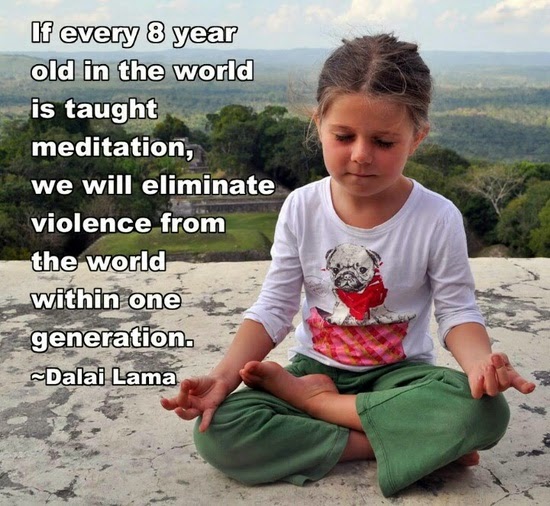
Sometimes when I have mentioned mindfulness to someone I've just met, they will ask me, "What's Mindfulness?" Well, it's not Buddhism or any religion, nor meditation or yoga, which are tools that we can use on the way to Mindfulness.

Kabat-Zinn's working definition of Mindfulness is "paying attention on purpose non-judgementally in the present moment as if your life depended on it." Now that's a mouth full! For me, being mindful means being fully awake, aware, alive in the present moment.

The last three characteristics of Doing versus Being (or of Mindfulness) mode are as follows:

5. Avoidance versus approaching--

Instead of trying not to think of something, such as some fear, which only enhances your anxiety, the Being mode encourages you to approach and to acknowledge the very thing that you feel like avoiding. This compassionate approach gradually dissipates the power of your negative feelings.

6. Mental time travel versus remaining in the present moment--

Living in the past often puts you in a regretting mood ,while living in the future may put you in worry mode. "We re-live past events and re-feel their pain, and we pre-live future disaster and pre-feel their impact," write Williams and Penman.

Don't allow yourself to get lost in a mental time warp. See memory as memory and worrying as worrying. Consciously know that you are remembering or that you are worrying about or planning for the future. This acknowledging helps free you from being a slave to mental time travel. You will be able to avoid the extra pain that comes from re-living the past or pre-living the future.

7. Depleting activities versus nourishing activities--

Sometimes life gets so demanding with projects in our professional lives and in our personal lives with on-going projects such as homemaking, childcare, or elder care that it's tempting to focus on these projects to the exclusion of our own health and well-being. You tell yourself that such busyness is temporary, and so you forego interests, hobbies, and pastimes that nourish your soul. Such thinking and Doing can drain away your energy and innate happiness.

For me, teaching would drain away my energy, but when I found kayaking, I discovered something that could replenish my energy and spirit. Nature and river and trails! And kayaking a white water river could always keep me very mindful and present; actually, that's true of any river really. Somehow being out on the river with the sky above me and the water (and sometimes those mountains) all around me connects me to and nourishes my soul.


------------

In the past and most of my life, I have lived too much in my mind, constantly analyzing, and striving for perfection and  approval. I had thought that my thoughts were reality, that they were me, that they were true, and I probably avoided those who didn't think the way I did. My mind was often in the past (if only a few hours back regretting something I had said or done) or in the future (if only a few hours ahead planning for the next day's lesson!), and I found myself often fatigued, even exhausted at the day's end.

According to Williams and Penman, characteristics of the Doing mode include judging everything, comparing the way things are with the way you want them to be and striving to make them different from how they actually are. Being on automatic pilot much of the time and getting lost in thoughts that you take too literally and personally. Living in the past or future and avoiding what you don't like. Finally, the Doing mode sees the world indirectly, through a veil of concepts [delusions] that short-circuit your senses so that you no longer directly experience yourself and the world.

Is this the way that you want to live your life? I have been extremely guilty of taking things too literally and too personally. And of trying to "improve" things that I really had little power over. What a waste of precious time and energy!

Characteristics of the Being or the Mindfulness mode include nourishing activities, being in the present moment, approaching and acknowledging, viewing thoughts as mental events, accepting, sensing, and conscious choices.

Would you like to live your life this way? I know that that is how I want to live!

To make a conscious shift to the Being or Mindful mode takes practice. After all, it took many decades for us to "perfect" this Doing mode of rapidly getting things done or jumping from one task to another or multi-tasking.

Toward the end of my teaching career, as my students would call out my name for attention time and again, I would tell them that I could only mono-task! That's one way I slowly began to shift gears to the Being mode or to becoming more mindful.

So how do we begin to shift gears? How do we engage ourselves with the Being mode? How do we become more mindful?

In the present moment, of course.

To be continued . . .


Tuesday, June 10, 2014

Seven characteristics of the Being versus the Doing modes of mind or modes of living


Presently, I am reading Mindfulness: Finding Peace in a Frantic World by Mark Williams and Danny Penman from which I get these seven characteristics of Doing versus Being. Besides Our Town, Thoreau, and Buddhism as mentioned in my former blog post, other early influences on me concerning mindfulness include Thich Nhat Hanh, especially his Living Buddha, Living Christ, and anything by Jon Kabat-Zinn (son-in-law of Howard Zinn, who wrote the amazing A People's History of the United States).

Kabat-Zinn tells us "the cultivation of mindfulness may just be the hardest work in the world," yet paradoxically, he further says that "a lightness of being and playfulness [are] key elements to the practice of mindfulness, because they are key elements of well-being."


Here are four of the seven characteristics of Doing versus Being (or Mindfulness). (I'll cover the other characteristic in my next post.) See if any of these characteristics "speak" to you as they did to me.

1. Automatic pilot versus conscious choice--

Autopilot means thinking, working, eating, walking, or driving without clear awareness of what you are doing. The danger is that you miss much of your life in this way.

Mindfulness brings you back, again and again, to full conscious awareness: a place of choice and intention. It provides you with the ability to "check in" with yourself from time to time so that you can make intentional choices.

2. Analyzing versus sensing--

Doing mode needs to think, analyze, recall, plan, and compare. In this mode, we spend a great deal of time "inside our heads," without noticing what's going on around us.

Mindfulness is a truly different way of knowing the world. It puts you back in touch with your senses so that you can see, hear, touch, smell, and taste things, as if for the first time (beginner's mind). You become deeply curious about the world again. Gradually, you cultivate a direct, intuitive sense of what is going on in your inner and outer worlds, without taking anything for granted.

3. Striving versus accepting--

The Doing mode involves judging and comparing the "real" world with the world as we would like it to be. It narrows our attention down to the gap between the two, so that you can end up with toxic tunnel vision in which only perfection will do.

Most of my life, I have been a perfectionist, wondering what made me this way and knowing that it made me crazy. Recognizing this toxic habit, I have been able to move beyond it, but it still haunts me at times and make me feel "less than." Finally, I've learned to say/think, that's "good enough."

Being mode invites you to suspend judgement. It means temporarily standing aside and watching the world as it unfolds, without preconceptions. It means allowing the world to be just as it is for the moment. It allow you to observe the world, rather than judge it, attack it, argue with it, or try to disprove its validity.

Or in my case, try to improve it.

Mindfulness liberates you from unhappiness, fear, anxiety, and exhaustion.

4. Seeing thoughts as solid and real versus treating them as mental events--

This characteristic of the Doing mind really resonates with me. For some reason, I mistook my thoughts for reality! I've always been too good at thinking, planning, and doing. My thoughts ceased to be my servants and became my master and a very harsh and unforgiving master at that. In the Doing mode, you tend to get on this treadmill of judging yourself: I should be able to cope better than this. I am weak. I am no good.

So you strive harder and harder (See number 3 above).

Mindfulness teaches us that our thoughts are just thoughts; they are events in the mind, mental events if you will. Furthermore, our feelings, too, are just feelings; they are not us.  Neither your thoughts nor your feelings are "you" or "reality." They are just your internal running commentary/emotions on/about yourself and the world. They come and go, come and go continually, but they are not you.

This simple recognition/realization frees us from the distorted reality that we have all conjured up for ourselves. With Mindfulness, we can see a clear path through life once again.


Now, more than ever, we (the world) needs mindfulness. "Our lives are now driven by the ever-quickening expectations that we place on ourselves and that others place on us and we on them. [These expectations are] generated in a large measure by our increasing dependence on ubiquitous digital technology and its ever-accelerating effects on our pace of life," according to Kabat-Zinn. With which, I agree wholeheartedly. We must learn how to use technology mindfully, and in our homes and in our schools, we must teach our children/youth how to do so also.

Mindfulness is a way of saving our world from destroying itself.

Did any of these Doing characteristics resonant with you, as they did with me? In my next post, I will share the three other characteristics of Doing versus Being mode with you, as well as give you a definition of Mindfulness and perhaps some ways to begin the practice of Mindfulness, if you are ready.

Sunday, June 8, 2014

For how shall we live?

When I retired from teaching high school English, I asked myself, "What was the most important thing that I had taught my students?" Though most of my students probably wouldn't know how to identify it (or it would vary for each of them), for me, the answer came back immediately--Mindfulness!

What do Thornton Wilder's play Our Town, Buddhism, and Thoreau have in common? In the first year of my teaching 1972, I began to teach Our Town, and though it wasn't popular to teach into the 21st century, I continued teaching it through 2010 until I retired and never tired of it.

You may remember that in that play Emily has died in child birth. When she comes back from the dead to relive her 12th birthday, she realizes that we human beings do not appreciate life while we live it. She spoke these words, and I immediately knew them to be true (the italics are mine):

"Emily: Oh, Mama, look at me one minute as though you really saw me. Mama, fourteen years have gone by. I'm dead. You're a grandmother, Mama! Wally's dead, too. His appendix burst on a camping trip to North Conway. We felt just terrible about it - don't you remember? But, just for a moment now we're all together. Mama, just for a moment we're happy. Let's really look at one another!

I can't. I can't go on. It goes so fast. We don't have time to look at one another. I didn't realize. So all that was going on and we never noticed. Take me back -- up the hill -- to my grave.

But first: Wait! One more look. Good-bye , Good-bye world. Good-bye, Grover's Corners....Mama and Papa. Good-bye to clocks ticking....and Mama's sunflowers. And food and coffee. And new ironed dresses and hot baths....and sleeping and waking up. 

Oh, earth, you are too wonderful for anybody to realize you. Do any human beings ever realize life while they live it--every,every minute?

Stage Manager: No. (pause) The saints and poets, maybe they do some."

Now fast forward in my teaching life to about 20 years later in the mid 90s when I began to teach about the major world religions through literature. Besides Christianity, my favorite of those faith traditions was Buddhism--primarily because one of its main tenets is mindfulness or being fully awake:


The Buddha advocated that one should establish mindfulness (satipaṭṭhāna) in one's day-to-day life, maintaining as much as possible a calm awareness of one's body, feelings, and mind. Mindfulness, which, among other things, is an attentive awareness of the reality of things (especially of the present moment) is an antidote to delusion.

As I thought back to the religion that I am most familiar with--Christianity--I realized that Jesus lived an incredibly mindful life. Didn't Christ live in the moment and encourage us to do the same? Wasn't he fully awake and alive? Spiritually in tune.

Excuse the words on the picture, which I cannot erase and which have nothing to do with my blog post! I actually have this picture on my wall. It is one of my favorites of Jesus.


"Therefore I tell you, do not worry about your life . . . do not worry about tomorrow." (Matthew 6) Isn't Jesus telling us to "stay in today" in this passage? "Let the little children come to me . . .for the kingdom of heaven belongs to such as these." (Matthew 19) Jesus tells us to become like little children if we seek the kingdom of God. Before society (we) corrupts them, don't children live fully in the present moment?

And then there is always Henry David Thoreau's Walden, telling us to simplify, slow down, and live in the present, "Let us spend one day as deliberately as Nature." Thoreau didn't just write about mindfulness, he lived it, especially at Walden Pond. He was teaching us that if we don't live mindfully, we will miss our lives. "The mass of men lead lives of quiet desperation." "We must learn to reawake and keep ourselves awake." "Only one in a hundred million [is awake enough for] a poetic or divine life." Isn't that the Stage Manger's answer to Emily's question in Our Town, "the saints and poets maybe"?

Thoreau cautions us about not living: "I went to the woods because I wished to live deliberately, to front only the essential facts of life, and see if I could not learn what it had to teach me, and not when I came to die, discover that I had not lived."

Still and all, though intellectually, I knew that mindfully was the way to live and that most of those whom I admired (living and dead) lived in the present, I was too much in the "doing" mode. Always doing, doing, doing, or if not doing, thinking about doing or going, going, going. Making long lists of what I "had" to do, where I had to go.

Why/how had I come to believe that living was all about doing and going? Running errands, working, cleaning, organizing, shopping, cooking, washing, planning lessons and grading papers, taking care of my child and pets and yes, husband, gardening, weeding, raking, paying bills, etc.

Wasn't I on that proverbial hamster's wheel? But how to get off?

Years and years ago, someone had said to me, we are human beings, not human doings. And I wanted to learn how to be more of a human being. But I didn't know how.

Oh I've had my moments: floating down the Hiwassee River in the late afternoon when the sun sparkled off its crystal clear waves, walking to school underneath the white pines with the early morning dew drops sparking off their evergreen needles, looking at my students' sparkling eyes and young faces as they comprehended the lesson for that moment. Apparently, one thing that I have discovered for sure is that living in the moment is a "sparkling" experience!

Thoreau said, "Only that day dawns to which we are awake. We must learn to reawaken and keep ourselves awake by an infinite expectation of the dawn. To be awake is to be alive."

With that in mind, I have been doing--there's that word again--some research on mindfulness. In my next blog post, I would like to begin teaching us how to be more mindful, more awake, more alive in our lives. Because it's never too late to learn how to really live! And we shall start with the "being" mode versus the "doing" mode of living and how to tell the difference. So stay tuned, Dear Reader!

Friday, May 23, 2014

Cursive writing--an essential!

A friend of mine told me that she had had lunch with a friend of hers--an archivist. The archivist mentioned how disappointed she was with her new intern. "What are your concerns?" my friend asked. "She can't read," the archivist stated. "She's a junior in college. How it it possible that she can't read?" my friend questioned. "It's not that she can't read at all," the archivist explained, "but she can't read cursive writing, a critical skill when working with historical documents."

This story makes me wonder if the reading and writing of cursive writing will one day be like knowing a foreign language!

In 2010, Common Core State Standards Initiative (CCSSI) aimed to standardize math and language arts requirements across the United States. Apparently, the instruction of cursive writing had been declining for years, and it seems that the CCSSI's omitting any mention of cursive writing in their curriculum pretty much rang the death knell for the teaching of it in our nation-wide elementary schools.

Yes, "correct" cursive writing is something that is difficult to test for!

As far as educational philosophy is concerned, I am an essentialist. I believe that certain things are essential to a "proper" education. Having been a high school English teacher, there are certain authors and literary works that I think are essential--but that's a post for another day!--there are certain speaking and writing skills that I believe are essential to a quality education--another post for another day.


I've also come to believe that cursive writing is essential for a complete education.  An article that outlines more detailed scientific information about the value of learning script or cursive writing can be found in a recent Psychology Today magazine, entitled "What Learning Cursive Does for the Brain."

Before retirement, I had begun to notice that some of my students printed everything. Now I wonder if they simply didn't know how to write cursively. Perhaps their elementary school teacher had skipped that particular skill, just as my daughter's elementary teacher omitted teaching her students the capital cities of the states!

Just because much of our "speaking" and writing is done with a keyboard doesn't mean that we won't need to use our fingers and hands to write on occasion. But there's something even more important to cursive writing than this need.

The same friend who told the above story about the archivist considers learning cursive writing to be a "rite of passage" into adulthood, like using an ink pen. She further tells me that practicing her penmanship led to her love of writing, "As I moved my fountain pen across the lined paper, my writing became my voice. I wanted to read more to gain the knowledge to write more. My vocabulary, spelling, grammar, and sentence structure all improved [with cursive writing]."

In hearing about this movement toward not teaching cursive writing, I thought about personality development and how my cursive writing has changed/matured over the years with my personality. It's fun to look back and see how you used to write in grade school, high school, college, early adulthood, etc. Cursive writing generally show your personality development.

Remember when you used to get a card or letter through snail mail, you could tell from the handwriting on the envelop who had sent it. As a teacher, if a name on a paper was missing, I could usually tell by their handwriting whose paper it was. Handwritten notes are usually more appreciated than emailed ones.

How I cherish today some handwritten recipes from my mother! When I tenderly touch her faded writing, it is as if I am touching her.

Also remember how handwriting analyzers are able to tell us about some of our personality traits from our handwriting. Someone's handwriting is their "signature. A part of them that is unique," my friend states. So if a person doesn't learn cursive writing, might that somehow change her/his personality development? His/her uniqueness? If we all write alike--from a computer keyboard--won't we be more like little automatons who do not have our own individual thoughts? (perhaps more Big Brother mind control--re-read the George Orwell novel 1984)

I, for one,  believe that we would. That's why I think that the teaching. learning, and practice (though I'm sure that it takes time and patience) of cursive writing is paramount to a quality education and to a person's personality development and uniqueness.

Let's bring back this essential skill--cursive writing!
An interesting sidenote: Since I was raised in the 50s, I guess that I learned cursive writing in third or fourth grade. When I began seventh grade in a new school, DuPont Junior High School, the English teacher there--a really old gray-headed lady (probably she was in her late 40s!)--told us students that most of our handwriting had become adulterated. She told us that in addition to the usual seventh grade English lessons she was going to teach us cursive writing from scratch! And so we all began again to learn our letters and to practice and practice. By then I had begun to write back handed like my mother--though neither of us was left handed--and it wasn't pretty. So I was taught once again to slant by letters to the right. At the time with my budding teenness, I resented having to learn cursive writing again, but of course, like many good lessons in life, it turned out to be a great value for me.

Friday, May 9, 2014

Schools are not mere machines

Yesterday, as I was listening to NPR, there was "leader/expert" in the field of education saying that our education system is over 100 years old and that it is like the model-T. His point seemed to be that either we can tinker with it to get it running again, or we can replace it with the latest model. Whatever model that may be?

I don't believe that this was a appropriate metaphor to describe the education system. Because a school is made up of humans, it is a whole lot more complex than an automobile has ever been, and a classroom is certainly not a mere machine. Thus this metaphor makes improving education sound too simple. Which I think that a lot of non-thinking politicians have fallen for.


A somewhat typical mind-set of a technological/industrial society, this man's metaphor implies that if it doesn't work, we can just fix it. Of course, I myself like to say, "If it ain't broke [broken], don't fix it." I also like to quote, "Don't throw the baby out with the bathwater!" Which replacing the model T completely with a new model of automobile would do, as would somehow creating a completely new model for schools would do. It would throw the good out with the bad. And our 100-year-old education system has had a lot of good in it, a lot of good worth saving!

In the last decade, it appears that "fixing" education means more and more testing of students. More and more taking away job security (tenure) and freedom to teach and to be creative from teachers. Testing of students has also been connected to teachers keeping their jobs or perhaps getting "merit" pay in some school districts. Testing students forces teachers to "teach" to the tests, to some generic tests that the state or federal government (Common Core) has come up with, not a test that the teachers themselves have created.

Who decides which questions to put on a multiple choice test? Can such a test really come up with 50 or so questions that reflect what each student knows and what each teacher has taught? Before I retired in 2010, I remember teaching to these tests with my English II (sophomore) students because I was being judged as a teacher by something called value-added (some mathematical equation that hardly anyone could explain to us). Some years my value-added score was good, some years not so good though I could not tell what I had done differently. Perhaps I had different students.

The tests themselves had faults. First, some of the questions on the test were particularly specific and often insignificant, "Where would you put the comma in the following series?" when indeed the comma was optional, and secondly, other questions were opinions as far as the answer went, "What is the most important sentence in this paragraph?" Important how? Important to whom?

So I was forced to take up valuable class time making sure that my students would "play the game" of testing, rather than get on with teaching material that I considered valuable; material that could not be measured by any test, such as how to treat your fellow man, how to value yourself, how and why to speak correctly, how to write a coherent composition, etc., etc., etc.


A state or federal test cannot measure the value of a student nor of his teacher, for we are not machines. It cannot truly measure on any given day what a student has learned nor what a teacher has taught. For we are complex human beings.

We are complex human beings with multi-dimensions. We are mental and emotional. We are solitary and social. We are spiritual and physical. We come from different genetics and different environments. Thus we cannot be judged by the exact same criteria. We cannot be programmed like a computer to perform on tests. We cannot be programmed like a computer to teach a certain way or to teach only certain material. For we are humans. Not model Ts nor Cadillacs.


There may be many ways to improve public education, but generic state or federal testing is not one of them. At least not the way testing is presently being done in Cheatham County or in Tennessee. Even though most states opted onto the Common Core curriculum and testing as soon as our federal government offered it, and Tennessee later than some, many states are now seeing that it is not the answer or even an answer and are opting out. Many parents are also opting out, too, by not allowing their children to take such tests.


Some parents have been concerned about the impact of such high stakes testing on their children and on their children's teachers and on on their schools. According to Time magazine (April 21, 2014) test protesters hope that the parental opt-out movement "crushes the system, says Janet Wilson, an activist from upstate New York. "This is our way of civil disobedience."

So if only a few Cheatham County parents were courageous enough to start a movement to opt their children out of Tennessee's state exams, then that would be a step in the right direction to take back our schools and put them back in the hands of the educators-- the teachers and local school administrators who are educated/trained to effectively run a classroom or a school. Teachers and local principals who have a love of learning and a passion for our youth, not who are trying to make some political statement nor trying to reach some "pie-in-sky" educational goal.

So I dare Cheatham County parents to be civilly disobedient (as Thoreau encouraged us to do when the government was wrong). I encourage parents to take back their schools by opting their children out of state or federal testing--out of Common Core exams. The teachers and principals hands are tied on this matter. Only you can do it. Then, and only then, can we talk about improving education in Cheatham County.


This picture seems to be a private school situation because of the small number of students, and yes, because of the "uniforms." One of the ways to improve education is to lower the teacher-to-student ratio. As any parent who pays for private education knows, fewer students per teacher means a better quality education.  When I have visited private school classrooms, the ratio was usually one teacher per 10 or fewer students!

Sunday, April 27, 2014

A memoir: the most important high school years

For a few years, fate threw us together in the same high school in the mid 1960s--the class of 1967 from Madison High School--and yet those years have left their indelible mark on our lives. We were the Madison Rams, our colors were orange and white, and we had merged into the high school, then 7-12, from four or more elementary schools. A few of us were catholic, two were Jewish, the rest of us were wasps--white, Anglo-Saxon, and and protestant. Although the Supreme Court had ruled segregation to be a violation of the 14th amendment in 1954, we were not yet an integrated high school. Most of us came to Madison High School still clinging to friends from those earlier schools. Some of us were ready to spread our wings and make new friends.

Last weekend about half of us met for our 47th class reunion. Most of us will turn 65 this year. As a memorial board cataloged, twenty of us have already died.

I came to Madison High School at the end of my freshman year and stayed until very near the end of my junior year. Coming from Louisville, Kentucky, where I had unhappily been since 7th grade, I was ready to make new friends and renew some old friendships from my elementary years.

For you see, I had gone to one of those elementary schools that merged into Madison High School for a few years before my family moved to Louisville, Kentucky. When I was in the third grade, we had moved from Richmond, Virginia, to Madison, Tennessee,  We lived on Berwich Trail with the mighty Cumberland River in our back yard, and I rode my bike to Neely's Bend Elementary School for the next three happiest years of my young life.

Last night at the reunion, many of the people that I remembered best had gone to both my elementary school and Madison High School. That may have been true for others, too, especially for those who had been together from first grade through twelfth grades. One man was going around and finding each of us from "the school on the bend"--Neely's Bend Elementary--and asking if we remembered each other. I certainly remember him.

When I was driving to the reunion at Old Hickory Country Club, I got to take a short walk down memory lane. Once I exited Interstate 65 North (which had not been there in the 60s), I passed by the old Madison High School on my left, which is now a middle school. I have always liked its welcoming u-shaped facade and am glad that the old building has not been torn down. Even before that, to my right I had recognized the name of the street that I had lived on when I was in high school--Marthona Road. I took a quick turn and looked for the old brick ranch house--the first house my family had ever bought, instead of rented--but could not recognize it. If memory served me, we paid $12,000 for that rather nice house! There were other street names--Graycroft, Vantrease, and Due West--that I recognized from the days that I was first learning  to drive.

1965-66--the school picture from my junior year in high school--On the back of the picture, it says Quill and Scroll (I was on the newspaper staff of The Ram Page, wrote poetry, and was to be the literary editor my senior year) and National Honor Society.

As I passed the familiar street names, my memory went back to an incident when I could have easily died. One of the things that we did back then was to drive past the house of our current crush, in hopes of seeing him or just to feel near him, I guess. Anyway a friend (Barbara Dunlap, I believe) and I had just driven past Tommy Cooper's (my latest crush) house and honked. Curious, he quickly came out of his house, jumped in his car--a Volkwagon Beetle, of course--and began to follow us. Not thinking, barely breathing, and not wanting him to know that it was me, I naturally sped up to get away from him. I was in my father's powerful, big Buick, and within minutes, we were at Gallatin Road, a major thoroughfare in Madison. Barbara screamed to me that the light was red and that I had to stop, but I told her that I couldn't and to hold on, because we were going through the red light. As we made it through, Barbara looked back to see that the cars on Gallatin Road had swerved to the shoulders to avoid hitting my car and that Tommy had stopped at the light. I just kept going--so afraid that the police were going to find and arrest me and put me under the jail! So afraid that my father was going to find out!

Tommy Cooper at Barbara's house. When I first met him, my sophomore year in high school, he was going steady with a girl named Cindy. Forbidden fruit, I chased him until I caught him in my junior and his senior year. I had dated another brown-eyed, handsome boy named Charlie Ligon through my sophomore year. 

When I walked into our 47th class reunion, a man came up to me saying, "You're Laura Drawdy, aren't you? And you married Tommy Cooper, didn't you?" Then he asked me if I had known what Tommy had recently died of. I had just heard in the last month that Tommy had died this past year. I had completely lost touch with him. The last time I saw Tommy was when he sold me my first Honda CRV after my Sabb had gotten totaled in Chattanooga. That must have been around 2000 or earlier. Tommy and I had been lovers through late high school, even after I moved to North Carolina to finish high school, and into college. We had married when I was about 20 and stayed married a few short years while I worked as a cashier at a small grocery store in Clarksville and finished college at Austin Peay. Perhaps I should have stayed married to him, but I had married him to escape my home life and because everyone else seemed to be getting married. We really had little in common. One day he told me that he never wanted to have any children. Though I wasn't so keen on having children myself and certainly not anytime soon, that was just the excuse I used to divorce him. Then I began my all-consuming teaching career. Later, after the divorce, Tommy and I were friends, even seeing each other occasionally, until I met John Mallernee.

At the reunion, I kept asking myself, "Who are all of these old people? Men with grey, thinning, or completely bald heads? Lots of women with grey hair, too. In my mind's eye, these people had frozen in time and should not have aged! They had name tags with their senior pictures (I had not been graduated from Madison so had no senior picture), but the pictures were really too small for most of us to see very well, without getting out our readers! We would look at the name on the tag and then at the person's face and sometimes we would see a slight resemblance! Other times the resemblance was quite obvious!

It seems to me that back then, we only took pictures at Christmas time!

Having not been to a class reunion since my tenth one, it was great fun to see people from high school again. It was fun to see who I remembered and who remembered me. Only good for about three hours of socializing, still being somewhat shy, and with the round dinner tables crowded together to accommodate all of us, I'm sorry to say that I could not get around to seeing everyone that I would have liked to see and to talk with. About 100 of us were able to attend, 50% of our original class. What surprised me was that some of the rather plain-looking people in high school were the most attractive now in our 60s. One lady from my elementary school who said that she had five great grandchildren did not look much older than 50, if that, and she had the loveliest face. And some of the people who were the most attractive in high school were not so attractive now. One studly looking guy in high school now looked like such an old man! Though many of those bald and grey-haired men that I alluded to in the previous paragraph were mighty handsome men, in contrast to their high school days.

It was good to sit at a table with some old friends from high school for a couple hours. But a lifetime had passed so quickly before our very eyes that we had little in common. Having not seen most of these people for nearly fifty years, I felt tenuous connections to them, connections as thin as gossamer. They didn't know me, nor did I know them. Wow to those who had not left Madison, who still lived in the area. How they must have felt connected to one another! But for most of the rest of us who had gone our individual ways, we were just reminiscing that night, as I am here.


Check out a picture of this dog the year before when she was but a puppy in a blog post that I wrote about another incident in my Madison High School years. I think that I was trying to look "sexy" in this picture! I remember being so proud to have gotten that MHS class ring in my junior year!

One big thing for me in high school was the time that I had cheated in biology class. No, we didn't get caught, but I had felt bad all of these years--perhaps because it was wrong or perhaps because the teacher was so nice. Anyway, my friend and I had similar handwriting, and we were to memorize the names of  the major bones and the muscles in the body. She memorized one set, and I the other, then we exchanged papers. We both got a 100% on that test. When I asked my partner in crime if she remembered our cheating, she laughed and said that she did not remember the incident at all. So much for my decades-old guilt!

At the reunion, one of our classmates (the daughter of our chemistry teacher) was reading out fun trivia questions for us to answer such as "How many elementary schools fed into Madison High School?" and  "How many drive-in movie theaters were in Madsion in 1967?" when she shocked me by asking one personal question, "And who put those "for sale" signs in my yard?" I actually involuntarily raised my hand, but no one seemed to pay me any attention. But I was guilty as charged.

Let me tell you the story. It is one of my most vivid memories from my Madison High School years. I was in Mr. Jenkins chemistry class, and one day I got kicked out of class! Mr. Jenkins had once again lost control of his class and yelled at all of us to sit down and to get quiet. We misbehaved in his class because so few of us "got" chemistry. Except for some "eggheads" or "nerds" in the back row (you know who you are!), it was beyond most of our comprehension.

Anyway, as I said, Mr. Jenkins had lost his temper and yelled at the whole class to get quiet. In the meantime, Randy Fisher (who I'm sorry to say didn't make it to the reunion because I was going to fuss at him again!) was my lab table partner who sat next to me on those tall stools. Unknown to me, he was up to his old tricks and had just taken that big gold safety pin out of my plaid wool kilt and was taunting me with it. When I saw that he had it, I flipped my left hand over to him to indicate that he was to return the pin to me pronto. At about the same time, Mr. Jenkins just happened to look up from reading at his desk. He ranted at me, "Laura, get out of my class and go to the office immediately!" I heard a general gasp from the rest of the class as we were all rather stunted. I was a good student who had never been in trouble before.

I spent three days out of chemistry class, sitting in front of the office. When the principal Mr. DePriest came by, he asked me how yearbook sales were going. To which I responded that they were going well. I was ashamed for him to know that I was in trouble nor did he expect trouble from me. The vice-principle Mr. Bridgeman always took care of the trouble-prone students. He had told me that I had to go to Mr. Jenkins and ask him if I could return to class. Each morning during homeroom for three days, I went to Mr. Jenkins, apologized, and asked if I could return to his class. Each morning for three days, Mr. Jenkins ignored me. Besides all of my friends, my homeroom teacher Mrs. Eldridge seemed to be on my side.

Finally, Mr. Jenkins allowed me to return to chemistry class, but each day that I had been out of class and though I had tried to keep up, he had given me a zero--three zeroes that were to be averaged into my grade for the six-weeks! I had not told my parents about my getting kicked out of chemistry class. But when the report cards came out, there were those little blue Bs that I had gotten in all the six-weeks' grading periods before, and there, for the fifth six-weeks, was a big fat D, written in red!

Now I knew I had to explain that grade in chemistry to my parents, and I was plenty scared. When I did, they listened patiently to me and just said that Mr. Bridgeman had called them several weeks ago and explained the situation. They had been wondering when I was going to tell them! They figured that I had suffered enough already in silence and gave me no further consequence.

So my friends and I were out one night, looking for something fun to do, and we decided to "pay back" old (he must have at least been in his 40s!) Mr. Jenkins! I honestly do not remember who was in on the prank or whose brilliant idea it was, but we decided to do more than just roll his yard, we also "found" a dozen or so "for sale" signs to put in his yard. The next week at school was a nightmare of Mr. Bridgeman quizzing me and my friends about the deed. Knowing that I would get in even bigger trouble, all of my friends, some of who even confessed, remained loyal to me and kept me out of it. No matter how many times Mr. Bridgeman brought up my name, they would not incriminate me. I loved my friends for that.

That's how I learned the extremely valuable lesson that teachers are not always fair, and later in life, as a teacher myself, I would keep this message in mind. And I want Mr. Jenkins and his daughter (to whom we meant no disrespect) to know that as a teacher, I got more than plenty of pay back from my own students!