Pages

Thursday, June 25, 2015

Part 4 of a dream journey--days 2-4 in Yellowstone

On day two, Mary from the hotel advised me to go to the Grand Canyon of Yellowstone, and it was my favorite place that I visited in the park.

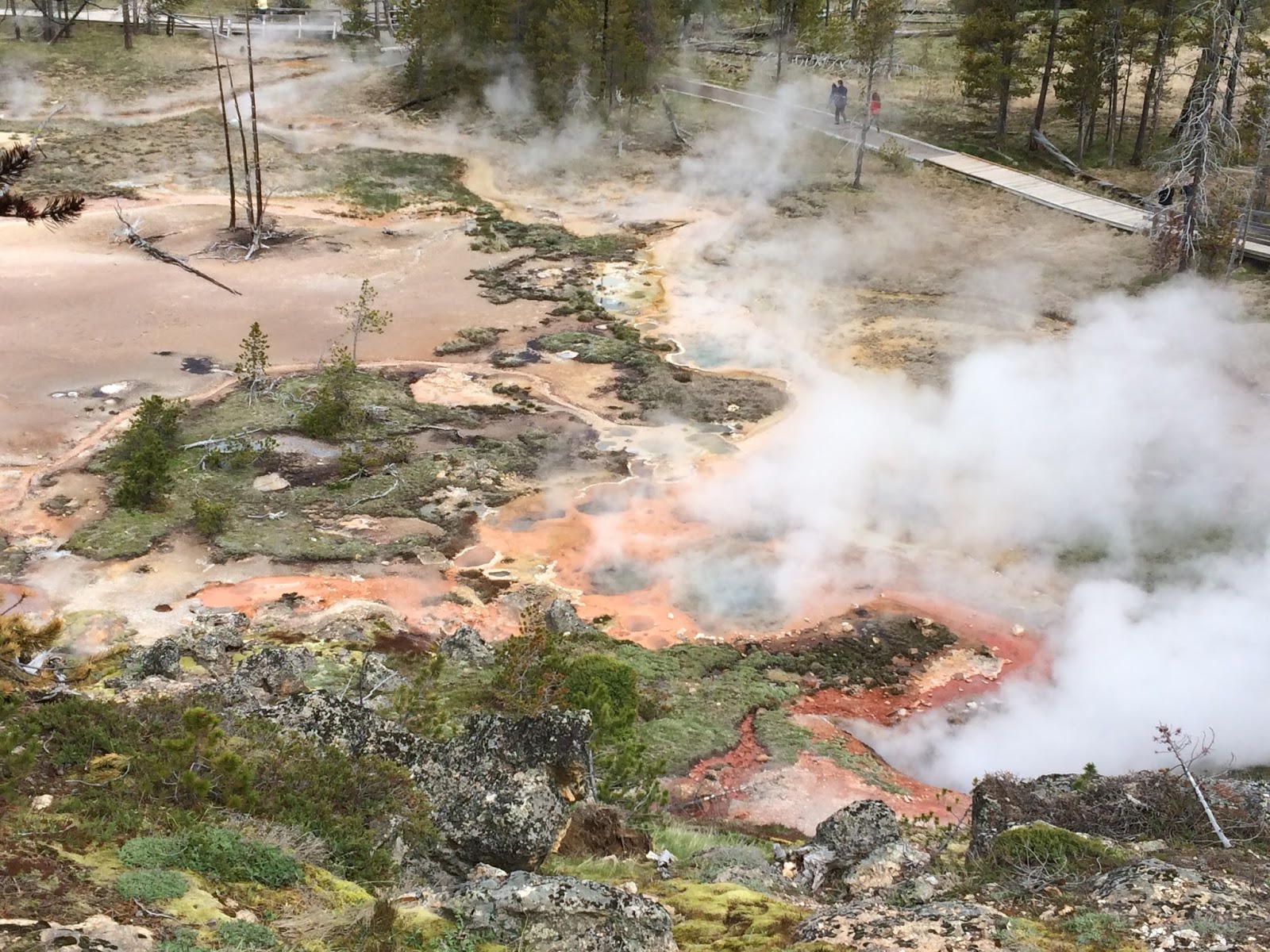
On the way to the canyon, I stopped to hike at the Paint Pots--and to watch those bubbling hot springs sprew their bright colors.


But it was the canyon that really mystified me! I could see immediately how Yellowstone Park got its name, and the waterfalls--both the upper and lower falls--were magnificent. And it was there that I first saw the Yellowstone River, which creates the waterfall below.


Stopping at a 1950's style cafe near the Canyon Lodge (which was not yet open), once again I had worked up a healthy appetite and appreciated a traditional lunch of delicious cheeseburger and fries. Thus ended another good day at YNP.

The next day back in West Montana, I decided to take a break from driving into the park. Instead I sayed in town and went to a bear (grizzly) and wolf sanctuary there in town. It was amazing to see those creatures so close up. They are truly beautiful wild animals.


Also I toured the historic Union Pacific train station, where in 1907 and thereafter, tourists used to come in on the train and then take stagecoaches through the park to the hotels. Until then visitation to the part was minimal because of its remote location, difficult access, and primitive accommodations. I took a step back in time as I toured the museum and the famous Union Pacific dining hall.


In my stay at West Yellowstone, Montana, I met so many people from all over the US and from other countries, such as the Netherlands and Australia. There were a lot of Asian tourists. One morning at breakfast when I asked an Asian woman where she was from, she answered, "LA! That's in California." West Yellowstone is a small town, but because of its gateway into Yellowstone, it's very cosmopolitan.

My last day in Yellowstone Park, once again I entered through the West Gate, but this time I drove 100 miles through the park to the South Gate, stopping at Mud Pots to hike to the mysterious Dragon's Mouth and other bubbling geothermal mud hot springs, where bufallo like to hang out to get warm in the winter. You'll see one fellow napping near a hot springs in the third picture below!


The number of geothermal features in Yellowstone--from geysers to hot springs to mud pots--is estimated at 10,000. YNP sits in a huge volcanic basin (caldera), which was the site of several massive volcanic eruptions, the last of which occurred about 600,000 years ago. These springs and geysers are caused by the build up of hot water and steam trapped below the surface.

Having seen enough geothermal features for this trip into Yellowstone, I was heading out, but it seemed that the antelope and bufallo did not want me to leave.


But by then, I was on my merry way to the Grand Tetons and famous Jackson Hole, Wyoming, to find out what made the Tetons grand and Jackson Hole famous, and nothing could stop me now--not even a few dozen bufallo!

Wednesday, June 17, 2015

Part 3 of a dream journey--Yellowstone!

Arriving in West Yellowstone, Montana, I settled into my hotel and made my nest for the next five nights. So this was Montana! Little did I know that this small town was the only part of Montana that I would visit. As in Boise, the town was surrounded by mountains, but these were higher and snow covered. These were the Rockies!


Though it was May 16, snow still lay on the ground in places from the unseasonable snowfall the week before my trip. I had packed two wool sweaters, two fleese vests, a light barn coat, wool socks, and my hiking boots. These proved to be plenty of clothes to keep me plenty warm for the next eleven days. Except for one day of rain, I found the weather to be cool, sunny, and perfect for my whole trip. There was no more snow!

Except to know that it was named the first national park in 1872, I had not done much research on Yellowstone because I wanted to wait until I got there. So the next morning, I met Mary, who worked there in the hotel, and asked her where I should go for my first foray into the park. She suggested that I may want to go about thirty miles into the park to Old Faithful--which had the most famous geyser as well as a famous old hotel. Though I knew that I probably couldn't afford to stay in them, old hotels were on my bucket lists of places that I wanted to visit and perhaps have a meal there.

The picture above is from my first entering Yellowstone National Park (YNP). Immediately in the park, I passed into the great state of Wyoming! The park was magical. Lots of moutains and swift rivers (This one is the Madison River.) and wild life--especially buffalo. Lots of close encounters with buffalo and their newly born calves. Also lots water falls (over 200 in the park) and lots of geothermal hot springs of many different colors from green to soothing turquoise to yellows and bright oranges. As I drove slowly (speed limit 45 mph) through the park, I might see steam rising from an area and came to realize that these were hiking areas (usually on raised wooden paths) to see hot springs.


Once I reached Old Faithful Inn, I had taken several hikes and built up a healthy appetite for lunch in the restaurant at the inn. I even got to enjoy huckleberry bread pudding--a real treat! After lunch, I was just in time to watch the Old Faithful Geyser, which erupts about every 90 minutes like clockwork! It was discovered in 1870, usually erupts for 90 seconds to five minutes, and rises from 100 to 200 feet.


After Old Faithful erupted, I scouted and hiked several acres in front of the inn and found many geothermal hot springs and one stream that allowed me to begin to see how Yellowstone got its name.


I said my farewells to Old Faithful Inn and geyser and headed back through the park, stopping often to hike and view other hot springs and Firehole River, which is a favorite river for fly fishing but in some places it is definitely a white water raging river on the edge of the park, created by the volcanic eruptions that created the whole park and that still apparently bubble below its surfice. (More on that later.) Firehole River contains three of the park's major waterfalls.


Thus ended my first day in Yellowstone.Who would have thought that going about 60 miles would have taken me all day? But besides the slow speed limit, there was just so much to see! And tomorrow I would view the famous Grand Canyon of Yellowstone Park National Park! 

Tuesday, June 9, 2015

A dream journey--part 2

As is obvious from my last post, it was those Grand Tetons that most impressed me on my trip out to the grand North West! (And more about the Tetons on another post.) Actually, all of my trip was filled with mountains, and I love mountains!

As you may recall, I flew in to Boise, Idaho, which was a way cool city to be in on the first night of the trip, and it was actually my first time in the state of Idaho. The city appears to be surrounded by lovely mountains--those kind of mountains that I had seen out in New Mexico and Arizona--the ones that are beautiful and all shades of brown.


The next morning I travelled east in Idaho toward Yellowstone in my small rented Toyota Yaris. Once I hit Highway 20, I was startled and swerved to avoid what appeared to be something coming my way from the prairie on the right. It was moving into the road and looked as if it could cause me to wreck, but I later discovered that it was only a double tumbleweed that had hooked itself together. None of the other cars on the road seemed to be paying any attention to them, so I quickly figured out that the tumble weeds may strike your car, but they were harmless; in fact, they could not even be felt. But oh my, they could be rather large and scarey at first--even bigger than giant beach balls!


As I continued to travel through Idaho, the brown mountains and hills gave way to green. Then on these mountains, there began to be pockets of evergreen trees. When the brown turned to green, I was in the Idaho's famous Sawtooth Mountains range.  After that, snow capped mountains begn to appear.


As I got closer and closer to the snow-covered mountains, lakes began to appear. Then all of a sudden, something changed!


Besides the lovely mountains and occasional lake, the most spetacular geographic display that I encountered that day was toward the end of my drive when I arrived in northwest Idaho at Craters of the Moon. For miles and miles, you drive through these amazing black lava fields and craters. You intuitively know that there must have been vocanos here at some time in the past. My research tells me that these other-worldly features are the result of basaltic volcanic activity between 15,000 and 2,100 years ago. Like so many places, no picture does them justice; you have to see them in person!


I stopped near and devoured my picnic lunch (chicken left over from dinner the night before) and stared into those dark earth crater and scruptures.


Little did I know that these craters were only a taste of what I was in for at Yellowstone National Park! If you tune in for the next installment in this blog, you may find out more than you ever wanted to know about that park. But really whether you have already been to Yellowstone (YNP) or are planning on going, I believe that you will appreciate what I have to share about it.

Tuesday, June 2, 2015

A dream journey

It had been years, perhaps even decades, that I had been dreaming of going to the GrandTetons, going to the Rocky Mountains! I had never been to Montana or Wyoming. I loved mountains and rivers. So earlier this year, I began the saving and the planning for this adventure.

Already I had learned that just seeing pictures of places was definitely not the same as going to those places!

Short outline of my trip: it was a solo journey. I flew into Boise, Idaho, staying one night there, rented a car and drove to West Yellowstone, Montana, for five nights, driving into Yellowstone National Park for three days. On the last of those days, I drove 100 miles through the park and exited the South Gate to drive to Jackson Hole, Wyoming, where I stayed for five nights, going into Grand Teons National Park for three days. Then I drove to Salt Lake City, Utah, stayed one night there and flew home the next day. All total, it was a twelve-day trip, and I was in four beautiful North Western states.

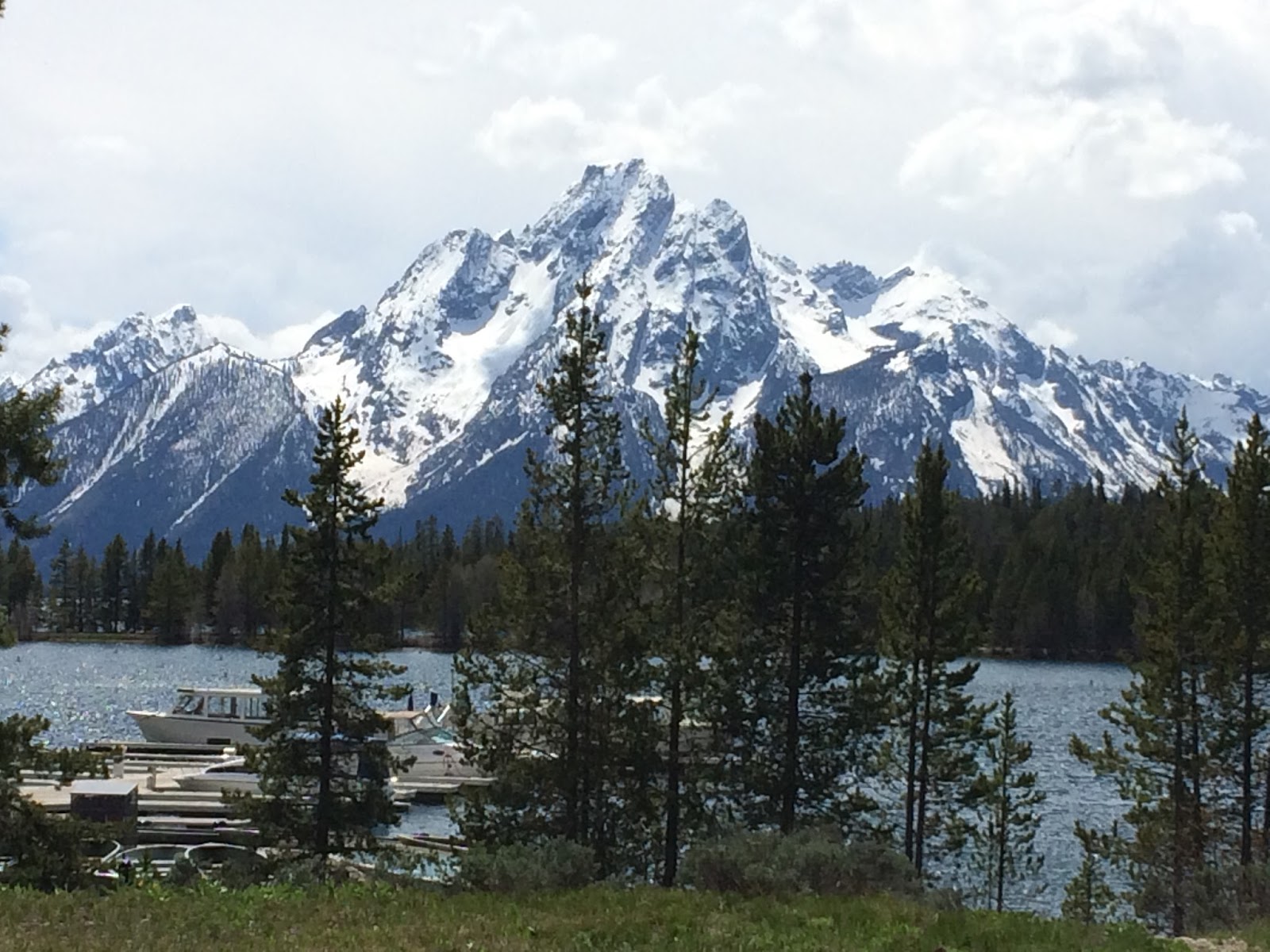
I am so completely happy that I did not miss seeing the Grand Tetons and the Rocky Mountains in person. As I traveled to Jackson Hole on the sixth day of my trip and rounded a bend in the road, they appeared to my right. They were magically lovely in all their rocky snow-covered heights against the bluest skies. They literally took my breath away! I had only experienced this kind of natural beauty three times before: in the Tennessee southern Smoky Mountains (near Byyson City), in the Grand Canyon, and at Yosemite.And now in the Tetons!


Still and all, as nice as the photos are, they do not do justice to the actual viewing expereince! I loved the Tetons immediately when I saw them.

I believe the photos above may be Turquoise Lake or Jackson Lake, but I'm not sure. More to come about the Tetons and Jackson Hole. And of course, about my dream journey!

to be continued


Tuesday, February 24, 2015

My Aunt Sandra Goes to Washington

It was the autumn of 1967, and I had just left my family in Seaford, Delaware, to seek an English degree from Middle Tennessee State University. My world centered on the fears and excitement of college life--and I carried with me concerns about my familymyself, my sister, and my parents. But around the country, and particularly in Washington, DC, things were really happening.

My Aunt Sandra was 22 years old that September--only four years older than I--when she landed the job that forever changed her life. Almost as a fluke (which she considers destiny), she was appointed personal secretary to United States Senator Strom Thurmond from South Carolina.

October 1967: My pretty Aunt Sandra is quite a bit taller than I am. She's 5'8" to my 5'4', but I think we look quite alike.

Shortly thereafter, the historical Ford Theater (where Lincoln had been assassinated) reopened with a gala performance in January 1968. On March 31, President Johnson announced he would not seek reelection. A few days later, on April 4, Martin Luther King, Jr. was assassinated in Memphis, spurring six days of race riots. After King's death, participants set up a 3000-person "tent city" on the Washington Mall for six weeks to gain economic justice for the poor in the United States. On June 6, Bobby Kennedy was assassinated in Los Angeles. On Jan. 20, 1969, with a ball held in his honor, Richard Nixon was sworn in as the 37th president of the United States (and we all know how that would turn out). In March of that same year, Dwight D. Eisenhower's body was brought to the United States Capitol, where he lay in state in the Capital Rotunda.

These are a just a few of the things that my aunt, Sandra Drawdy Courie, remembers and experienced because she lived and worked in DC from 1967 through 1969. There, she met head-honchos too numerous to name: presidents and vice-presidents, congressmen, Supreme Court justices, military chiefs of staff, foreign ambassadors, even Ann Landers!

If you are not from South Carolina, you may not know about the famous (or sometimes infamous) Senator Strom Thurmond. Born in 1902 in Edgefield, SC, he graduated from Clemson in 1923. He became the county attorney for Edgefield and then was elected to the South Carolina Senate in 1933. Beginning in 1942, during World War II, he served in the army, rising to the rank of Major General.

From 1947-51, he was the Democratic governor of South Carolina. Then in 1954, he was elected as a United States senator from South Carolina, switching to the Republican party in 1964. He served for 48 years in that capacity, and he lived to be 100, the oldest person to have ever served in Congress. Eight years after his first wife Jean died at age 33 of a brain tumor in 1960, he married his second wife Nancy in 1968. He was 66, and she was 22. Together they had four children.

Known for his pro-segregation policies, he helped propose a manifesto that opposed the Supreme Court decision to desegregate public schools in 1957. The decision was passed nevertheless and became the landmark 1957 Civil Right Act.

Ironically, it was later reported that Thurmond had a biracial daughter. At the age of 22, he fathered a daughter, Essie, with his family's 16-year-old African American domestic worker. Essie Mae Washington-Williams was introduced to her father during her teens and received financial support from Thurmond and visited him in Washington. She was a Los Angeles teacher with a master's degree. She did not publicly reveal that she was his daughter until six months after his death. She died 10 years later in 2013 at the age of 87.

...

If you are not from South Carolina, you also may not know about my famous Aunt Sandra! She is the youngest of nine children born to my paternal grandparents, Flossie and Fulton Drawdy. My dad, Ken Drawdy, was the second child born into that family. The story is told that when Ken called his mother to tell her that his wife Margie was pregnant (with their first child), her mother replied, "So am I." (She was pregnant with her last child!) So that's how I came to have an aunt only four years older than I.

Sandra was born and raised in Bowman, SC, a small town in Orangeburg County. Back in the '50s when cotton was king, this country town was situated in the center of what was a major cotton-producing area, where the rich clay sub-soil is ideal for growing cotton. As a child, when I would be taken on our annual summer visit to Bowman to my grandparents' farm, I was struck by the poverty of the place, by the intense heat, and by the barrenness of the land. As our car rambled down the long dirt road, I pressed my little face against the car window to take in the gleaming white cotton plants growing endlessly across the fields. Shanties would occasionally present themselves on the side of the dusty roads with numerous black faces peeping out, and tall pine trees grew scrubby against the bluest sky. The sandy soil invariably stuck to my sweaty, flip-flop-clad feet as I scampered around the farm yard. I was enchanted by the farm, its nature, and its numerous farm animals.

"My family always had plenty to eat, with two freezers full of beef, pork, and garden vegetables," remembers Sandra. "We had delicious mouth-watering hams curing in the smokehouse and a fenced-in yard for fresh eggs and fresh fried chicken on Sundays." After graduating from Bowman High School, which had a graduating class of 12 people, Sandra went to a two-year business college in Columbia and graduated with honors. She then worked at Pilot Life Insurance Company in Columbia. After her father died, she moved back home to Bowman to be with her mother, took a state administrative test (on which she surprised herself by scoring the second highest in the entire state) and got a job working for the South Carolina Vocational Rehabilitation Department. 

One day Sandra's mother called her at work to say that she had heard on the local TV news that Strom Thurmond was losing his personal secretary and sought a new one. "Mom told me that she wanted me to apply for the job." Sandra told her mother that she wouldn't get it, and she said, "I know, but at least you'll get a letter from Strom Thurmond!"

Mostly, just to please her mother, Sandra wrote a letter to the Senator's Washington office, applying for the job. "I received a call soon after that and was asked to meet with one of the Senator's South Carolina aides in Columbia. After the interview with his aide, the Senator called and offered me the position of his personal secretary at the then unheard of annual salary of $6,000 for a secretary." With Thurmond's thick Southern accent, it always came out as PUH-sun-al secretary.

With two weeks to prepare herself for the move to Washington, Sandra, her mother, and two of her sisters had a ball shopping for her new business attire; she remembers in particular one exquisite black dress that was perfect for all the DC receptions. Sandra found Washington to be the most impressive city that she had ever seen. She recalls that there on her left was the impressive Jefferson Memorial, all lit up and gleaming white. For the two years that she lived in Washington, she remained in awe that she worked in and around the Capitol building itself. Very early in her job, the Senator explained to her about not only making sure that things were done right, but also that they must look right to protect one's integrity. She remarked to him one night that the Capitol building was beautiful, to which he replied, "It is indeed beautiful, but there's a lot of 'dirt' that goes on under the roof."

Senator Thurmond liked his staff readily available, so Sandra's desk was right in his office. (He was the only senator to have this arrangement.) As his personal secretary, Sandra took care of things of a personal nature for the Senator: his appointment calendar, invitations, checking and savings accounts, all correspondence with his brothers, sisters, nieces, and nephews. She reminded him of appointments and committee meetings 15 minutes prior to the meeting or appointment and made sure that he appeared for votes on the Senate floor. Alongside the Senator, Sandra helped entertain constituents at lunches in the Senates' Dining Room in the Capitol and at other events.

It was while Sandra was still working for the Senator in Washington that he married his second wife Nancy in December 1968. When the Senate recessed around Thanksgiving through the first of the year, Sandra traveled to his home in Aiken, SC, each November/December as the Senator did. She got to know Nancy and all of the children well. Later, Sandra's own children attended their birthday parties. Years later in 1984, Sandra worked as Nancy's assistant for almost two years.

"Working for the Senator was an education unto itself; in politics, health (he was big on eating right and exercise), protocol, social studies, and much more on life lessons," Sandra stated. She was working with the Senator when he was courting Nancy, and one day he did something extremely special for her. Sandra remarked on his thoughtfulness, and he told her something that she's never forgotten, "The love you give is returned to you many times over."

Thurmond considered his Washington staff to be like family, and everyone who had ever met the Senator had a "Strom story" to tell. Highly intelligent with a good sense of humor, Thurmond would enjoy hearing the stories about himself as much as they liked telling them. Aunt Sandra tells one of her personal favorites:

Senator Bobby Kennedy's office was next door to ours in the Russell Senate Office Building. Although our staff was made up of staunch Republicans, we were still thrilled to see Bobby Kennedy pass by. He often was accompanied by his two rather large dogs, and one day those two dogs came directly into the Senator's private office and ran around his desk. The Senator asked, 'Miss Drawdy, what are those dogs doing in here?' I answered, 'Senator, those are Senator Kennedy's dogs.' He blinked his eyes and responded, 'Democratic dogs? I guess we'd better get them out of heyah on the double!'

March 1969: It looks as if the Senator is congratulating Sandra on her engagement here. That's why she left the job in Washington, to go home to SC and to get married.

As far as Thurmond's controversial politics, Sandra said, "It was the late '60s, and times were changing. I never heard the Senator speak unkindly of any black person. It was a different world when he entered politics, and his earlier views were out of vogue. He was a man of the times and felt he could do most good in serving his state."

When Sandra left the Senator's office to return home to SC and get married, Thurmond proclaimed at her going-away party that she had "one of the best minds" of anyone who'd ever worked in his office. Through the years, Sandra continued to work for Thurmond: on two of his re-election campaigns, as his wife Nancy's assistant, and at a half-dozen biennial reunions for anyone who had ever worked for the Senator. One of the reunions was held at Clemson when Vice-President Bush was the main speaker at the groundbreaking for the Strom Thurmond Institute.

Sandra and Strom remained lifelong friends. She attended his 90th and 100th birthday parties. The 90th was especially special, as Bill Clinton and Al Gore attended, and James Brown sang "Happy Birthday." During the last six months of his life, Sandra was one of a handful of friends allowed to visit him.

The Senator died in the summer of 2003. When his will was read, Sandra learned that he had left her (and a few other people) a small sum of money. She called her son stationed in Germany to tell him that she was "an heiress." A few minutes after reading the newspaper article online, her son called back to say, "Mom, the Senator didn't have many people in his will."

That's when Sandra knew just how much Thurmond had cared for her. Through 100 years of colleagues, family, and friends, she was one of the few who made a truly lasting impression with the Senator. In the years since his death, she says, "I've cherished this thought."

Friday, January 23, 2015

Memoir: My Great Aunt Pansy

Every time I dye my hair red (which I began doing decades ago to spice up the mousy brown), I think of my paternal Great Aunt Pansy, who also dyed her hair red. And for all I know, hers, unlike mine, was perhaps naturally red earlier in her life. I do know that red hair suited her personality well, as it did her wise blue eyes.

As a child, in my eyes Great Aunt Pansy was the rich one in our family. Sometimes when we went to visit my dad's family on the farm in Bowman, South Carolina, we would drop by Aunt Pansy's for a couple hours. Living in the city of Anderson, SC, in a really nice neighborhood, she had a brick house painted white, usually with a new Cadillac parked in her driveway.

Once inside the house, there were luxurious furnishings with the softest carpets on the floors and velvety towels hanging in the bathroom. The house sounded like laughter and always smelled nice, as did my Aunt Pansy. She wore the loveliest clothes my eyes had ever seen: saucy hats atop her head and sumptuous furs across her shoulders. Pansy was a country girl who had grown comfortable in the city. The elegance she had learned never could disguise the real Pansy--funny and down-to-earth, genuine, sprung from humble roots.

Born in 1905 on a farm in Orangeburg County, SC, she was the second daughter of Carrie and Charlie Ayers. The first daughter, born 17 months earlier, was Flossie, my father's mother and my paternal grandmother. These two daughters were the only children of their parents. Flossie went on to live in that same farmhouse and to have nine living children. In contrast, Pansy moved to the city, married twice, had a career. No children.
This is me, about the same age as Pansy was below. I never realized how much we favored until I saw this picture of her recently. I guess I do look like the Ayers sisters after all.

Pansy's first husband was Earl Hammerly, a professor at a small private college in the foothills of the Appalachian mountains in Rome, Northern Georgia. He was apparently older than she, a man of some means who had a chauffeur. After his untimely death, she married Harry Groce, a traveling salesman, who was gone during the week days. He adored Pansy and called her P.A., short for Pansy Ayers. Like his beloved, Harry didn't take things too seriously; he was full of laughter, jokes and pranks. Also like her, he was a sharp dresser. He smoked cigars, liked his bourbon, and drove a white Silverhawk Studebaker around Anderson, SC., where they lived together.

In the meantime, Pansy was named the manager of the Western Union office in Anderson. She invited two of her sister's grown children to live with her at various times. Once Flossie's first born graduated high school, CF (Charles Fulton) went to live with and work for Pansy, delivering Western Union telegrams. Later she sent him to Clemson College, then procured him a summer job at Carolina Beach, NC, where he met his future wife. His subsequent marriage and World War II changed his course, and he didn't return to college. A disappointment to her, I'm sure.

My Great Aunt Pansy in her younger days.

Flossie's third daughter Bonnie also lived with Pansy and attended Anderson College for a semester, where she met and married her husband. Pansy was said to be put off about her not continuing on in college. Still later, after CF had a son, my cousin Butch would visit Pansy for a fun-filled week during the summers, and she would buy him spiffy back-to-school clothes from the downtown J. C. Penney's. With Aunt Pansy's attention, Butch almost felt that he had two grandmothers on his father's side of the family. Butch remembers, "We always went to church on Sunday morning and then went to Clemson House in Clemson for a lunch of she-crab soup, roast beef with mashed potatoes and gravy and real strawberry shortcake for dessert. We would joke around about how could they tell if it was a she-crab or a he-crab. We would laugh and talk; there was never a dull moment around Aunt Pansy." Butch also recalls his family going to lots of Clemson football games with Pansy through the years.

Later in life, Pansy opened her home to a feisty little fleet of Chihauhaus who would nip at the heels of her guests, particularly of children. She dearly loved them. To me, they always looked like puppies, and I could think of nothing I wanted more. Finally, my family got a Chihauhau/Toy Manchester mix from her. We named him Jose, and I considered him my dog.

Little Jose and little me in Madison, Tennessee, during my best childhood years
Pansy remained close to her sister Flossie and sent money to help out with all of the children. When Flossie's fourth girl Sandra was a junior in high school, Pansy and her mama went shopping in Orangeburg and came back with a surprise for her: a beautiful white evening gown with layers of lace and a striking blue cummerbund, which she wore to her junior-senior prom.

Some years after Harry and Flossie's husband (my father's father and my paternal grandfather) died, Pansy retired from Western Union and moved into a nice house in Orangeburg. Still later she moved into the farmhouse in Bowman with her sister Flossie and had the farmhouse beautifully remodeled. Then a stroke took her to the nursing home in Orangeburg, where Flossie joined her several years later. She would enjoy keeping up with her beloved Atlanta Braves on radio and TV. Pansy died there in 1993 and is buried beside Harry in Anderson. Her sister Flossie died a year later.

Most of us who remember Pansy remember her with a smile on her face and on our faces. "Her chin would quiver when she was tickled," Sandra recalls. She loved to have a glass of wine in the evenings and is said to have been the life of any party. I regret not knowing her better. As a matter of fact, I'm beginning to feel that same way about many people in my father's family. Independent, fun and funny, quick witted, with a twinkle in her eye, my Great Aunt Pansy is a lady whom I remember with great fondness.